

D1 Day 1: the Main Market Square, St. Mary's Basilica and the university
- D1·1Barbican Landmark
- D1·2St. Mary's Basilica Church
- D1·3Cloth Hall Market
- D1·4Collegium Maius Museum
- D1·5Planty Park

Tickets for Wawel, Schindler's Factory and the Wieliczka salt mine are sold in timed slots: book them before you leave, and the rest of this plan is done on foot, one neighborhood a day. With two days, keep the Main Market Square and St. Mary's Basilica, then the castle and the Vistula riverbank; on the third, walk through Kazimierz and Podgórze, and on the fourth, go underground at Wieliczka, then climb Kościuszko Mound for the sunset.
© OpenStreetMap contributors
D1 Day 1: the Main Market Square, St. Mary's Basilica and the university
D2 Day 2: Kanonicza Street, Wawel Castle and the Vistula
D3 Day 3: Kazimierz, Podgórze and Schindler's Factory
D4 Day 4: the Wieliczka salt mine and Kościuszko Mound
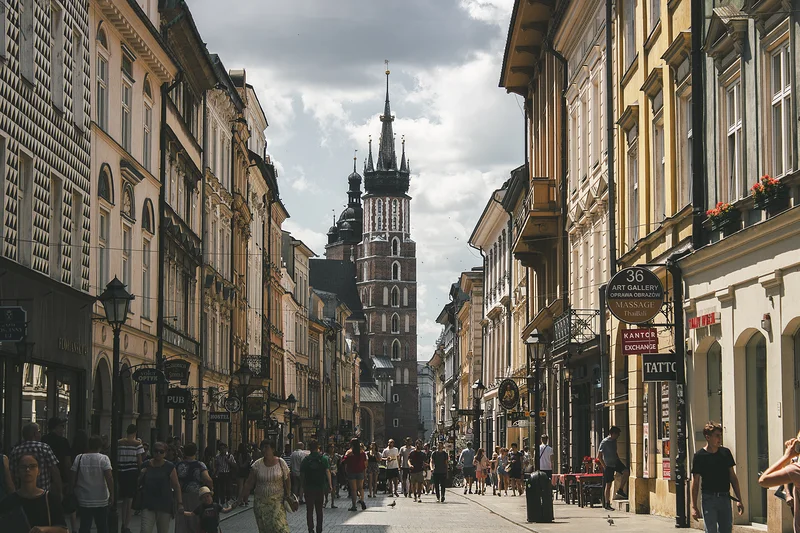
Enter the Old Town the way the kings did, from the north: the Barbican, a round fifteenth-century brick fortress, then St. Florian's Gate and Floriańska Street, which runs down to the Main Market Square. Buy an obwarzanek from the cart on the corner and reach the square before 11:30 a.m., while it is still half empty.
Monday to Saturday at 11:50 a.m., enter St. Mary's Basilica through the side door for visitors: the wings of the Veit Stoss altarpiece, the largest Gothic wooden carving in Europe, open in front of you. As you come out, wait for noon on the square: the trumpeter plays the hejnał from the tower window, and the tune stops in the middle of a note.
Lunch on pierogi in a side street, then go down into the Rynek Underground museum, booked the day before: it shows the medieval foundations found beneath the Cloth Hall. Then climb to the hall's upper floor, where the gallery of nineteenth-century Polish painting opens onto a terrace above the square.
Walk five minutes west to the Collegium Maius, the oldest building of the Jagiellonian University, where Copernicus studied: its arcaded courtyard is free, and the clock on the facade parades its figurines at set times. End the afternoon in the Planty, the ring of gardens planted where the walls stood, on a bench under the chestnut trees.
Have dinner at Miód Malina, on Grodzka Street, or in a vaulted cellar on a side street, rather than on the terraces of the square. Then go back to the Main Market Square around 11 p.m.: the terraces empty, the Cloth Hall and the basilica stay lit, and the hejnał sounds again at midnight.
Walk down Kanonicza Street, one of the oldest in Kraków, between the canons' palaces, to the hill. Start with Wawel Cathedral, where the kings of Poland were crowned and buried: climb the tower to the Sigismund Bell, then go down into the crypt with the royal tombs.
Then enter Wawel Castle at your booked time: the royal apartments hold the Flemish tapestries commissioned by King Sigismund Augustus, and the Renaissance arcaded courtyard is free to enter. Allow two hours for the cathedral and one castle exhibition.
Have a simple lunch at the Pod Temidą milk bar on Grodzka Street, or a bowl of soup in the center, then go back up the hill to come down through the Dragon's Den, a limestone cave open from April to October. It comes out by the river, in front of the dragon statue that breathes fire every few minutes.
Then follow the Vistula Boulevards west, below the walls, on foot or by bike. In summer, boats leave from below Wawel for a one-hour cruise, and moored barges serve drinks on deck, facing the castle.
Walk back up Grodzka Street to the Church of Saints Peter and Paul, its Baroque facade lined with statues of the apostles: classical concerts are held there several evenings a week. Then have dinner under the vaults of Pod Baranem, on Świętej Gertrudy Street, and head home through the Planty.
Walk to Szeroka Street, the heart of the old Jewish town, twenty minutes from the Main Market Square. Visit the Remuh Synagogue, still in use, and its sixteenth-century cemetery, then the Old Synagogue, the oldest in Poland, at the end of the street, now a museum of Jewish life in Kraków.
Come back along Józefa and Estery Streets, past their courtyards and workshops, to Plac Nowy and its rotunda, a former hall where poultry was slaughtered according to Jewish ritual: have a zapiekanka at one of the counters for lunch, or Polish food on a nearby street.
Cross the Vistula on the Bernatka Footbridge, hung with sculptures of acrobats. On the far bank, Ghetto Heroes Square and its seventy bronze chairs mark the place from which the ghetto's inhabitants were deported; the Eagle Pharmacy, on the square, tells their story.
Then walk ten minutes to Schindler's Factory, at your booked time: the exhibition is not only about Oskar Schindler, it covers the whole occupation of Kraków from 1939 to 1945. Allow two hours, and plan some quiet time afterward, by the water.
Walk back to Kazimierz over the footbridge at sunset, then have dinner on Szeroka or Józefa Street. Stay for a drink at Alchemia, on Estery Street, lit by candles, or for a klezmer concert in one of the halls on Szeroka Street.
Take a morning train from Kraków Główny to Wieliczka Rynek-Kopalnia, about twenty minutes, and walk to the entrance of the Wieliczka Salt Mine in time for your guided tour. You go down nearly 800 steps to 135 m (443 feet) below ground, past salt lakes and timbered galleries, and come back up by elevator.
The highlight is St. Kinga's Chapel, 101 m (331 feet) down: the miners carved everything in it from salt, the chandeliers, the altar and the reliefs on the walls. Allow three to four hours with the journey, and bring a sweater: the temperature stays around 17 °C (63 °F) all year.
Back in town, take the tram to the end of the line at Salwator, a district of villas on the Vistula, around the Norbertine convent. Walk up Waszyngtona Avenue, a gently sloping tree-lined road, to the mound, twenty-five minutes on foot.
Climb Kościuszko Mound, an earth mound raised in the nineteenth century in memory of the national hero, for the sunset: you see the whole city, Wawel and the Vistula, and on very clear days the Tatra Mountains to the south. Then come down by tram or taxi for a last dinner in Kazimierz.
You eat well and cheaply in Kraków: a full milk bar meal for $6.60, a plate of pierogi for $11, dinner for two under Gothic vaults for $66 to $88. Book dinner on Friday and Saturday, and choose the side streets over the terraces of the Main Market Square.
Milk bars
Pod Temidą (Grodzka 43), below Wawel: soup, pierogi and breaded pork cutlet ordered at the counter, at lunchtime, for a few złotys.
Under the vaults
Pod Baranem (Świętej Gertrudy 21) for classic Polish cooking, and Miód Malina (Grodzka 40) for pierogi and duck, in the Old Town.
In Kazimierz
Starka (Józefa 14), for Polish dishes and its house vodkas, and the restaurants of Szeroka Street for Galician Jewish cooking.
Coffee and cake
Jama Michalika (Floriańska 45), a historic café with caricatures on the walls, and Café Camelot (Świętego Tomasza 17) for apple cake.
In the evening, Kraków drinks in cellars, in the bars of Kazimierz and, in summer, by the Vistula.
| In the mood for | Where | Our take |
|---|---|---|
| A drink by candlelight | Alchemia (Estery 5) and Mleczarnia (Meiselsa 20), in Kazimierz | Old furniture, candles and a courtyard in summer |
| A vodka or a nalewka | Starka (Józefa 14), and the vodka bars around Plac Nowy | To taste the house liqueurs |
| An Old Town cellar | The vaulted bars around the Main Market Square | Always lively; loud on weekends |
Drinking in the street, in the Planty or on the riverbank is banned: have your drink on a terrace, or in summer on board the barges moored below Wawel.
Klezmer music
Concerts almost every evening in the halls of Szeroka Street, in Kazimierz, and the concerts of the Jewish Culture Festival, in late June and early July.
Chopin and classical music
One-hour recitals in the churches and salons of the Old Town, almost every evening, and concerts at the Church of Saints Peter and Paul, on Grodzka Street.
Piwnica pod Baranami
The cabaret cellar of the Pod Baranami palace (Rynek Główny 27), on the Main Market Square, open since 1956: songs and jazz on some evenings.
Opera and philharmonic
The Kraków Opera (Lubicz 48), near the station, and the Philharmonic (Zwierzyniecka 1), on the edge of the Planty, from September to June.
| Destination | Journey | What for | Our take |
|---|---|---|---|
| Auschwitz-Birkenau | Bus or minibus, ~1h30 | The former concentration and extermination camp, memorial and museum | A full day, booked weeks ahead |
| Tyniec | Boat in summer, ~4h round trip | The Benedictine abbey on its cliff above the Vistula | A peaceful half day, also by bike |
| Ojców National Park | Bus, ~45 min. | Limestone valleys, Pieskowa Skała castle and the caves | A day of easy walking, spring to fall |
| Zakopane | Bus, ~2h | The Tatras, wooden chalets and the Kasprowy Wierch cable car | Better with a night there |
Krakow
Pick your dates and see the offers from the major booking sites side by side.
Compare live offers from Booking, Expedia, Agoda and other partners.
Krakow: find your hotel
For the essentials, yes: the Main Market Square and St. Mary's Basilica on the first day, Wawel and the Vistula riverbank on the second. Kazimierz, Podgórze and the Wieliczka mine need a third and a fourth day.
At 11:50 a.m., Monday to Saturday, in St. Mary's Basilica, when the wings of the altarpiece open. Go in around 11:40 a.m. through the side door for visitors, and stay on the square at noon to hear the hejnał.
Yes, in summer and on weekends: tickets for the royal apartments are limited each day and sold in timed slots. The castle courtyard and the hill are free to enter; the cathedral has its own ticket office.
Pierogi and żurek in an Old Town cellar, a zapiekanka on Plac Nowy, an obwarzanek on a street corner, grilled oscypek at the market and a kremówka for dessert, with a nalewka in Kazimierz.
Some tours offer it, but the day lasts more than ten hours on a coach, and neither visit should be rushed. Do them on two different days, and keep a quiet evening after Auschwitz-Birkenau.