





D1 Day 1: Seville, arrival, the Alcázar and Santa Cruz
- D1·1Alcázar of Seville Landmark
- D1·2Seville Cathedral Church
- D1·3Giralda Landmark
- D1·4Santa Cruz Neighborhood

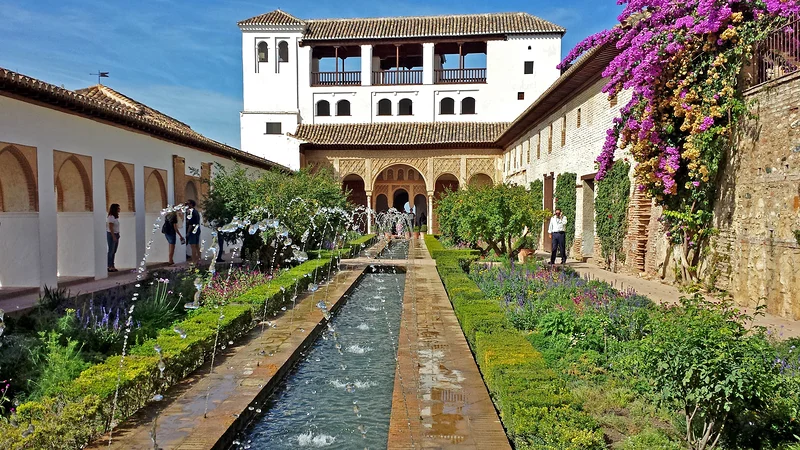
Eight days are enough for Seville, Córdoba, Granada, Ronda and Malaga, as long as you travel from west to east without doubling back. Spend the first two days on foot in Seville, pick up the car on the third morning at Santa Justa station, and return it at Malaga airport on the last day: 478 miles (770 km) over six days, with no tolls. The longest day is the sixth, almost three hours at the wheel from Granada to Ronda via Antequera and the white villages of Olvera and Setenil: leave at 9am.
© OpenStreetMap contributors
D1 Day 1: Seville, arrival, the Alcázar and Santa Cruz
D2 Day 2: Seville, the plaza de España and Triana
D3 Day 3: the car, Carmona and Córdoba
D4 Day 4: the road to Granada and the Alhambra
D5 Day 5: Granada, the Albaicín and the Sacromonte
D6 Day 6: the white villages road to Ronda
D7 Day 7: Ronda in the morning, then Malaga, the Alcazaba and the Gibralfaro
D8 Day 8: Nerja, the Balcón de Europa and back to Malaga
| Day | Stops of the day | Driving | Night in |
|---|---|---|---|
| Day 1 | Seville | No driving | Seville |
| Day 2 | Seville, Triana | No driving | Seville |
| Day 3 | Carmona, Córdoba | 140 km, 1h40 | Córdoba |
| Day 4 | Córdoba, Granada | 205 km, 2h10 | Granada |
| Day 5 | Granada | No driving | Granada |
| Day 6 | Antequera, Setenil de las Bodegas, Ronda | 210 km, 2h50 | Ronda |
| Day 7 | Ronda, Malaga | 105 km, 1h40 | Malaga |
| Day 8 | Nerja, Frigiliana, Malaga | 110 km, 2h | Malaga |
| Total | 770 km, 10h20 |
To get there and pick your season, see When to go and Getting there.
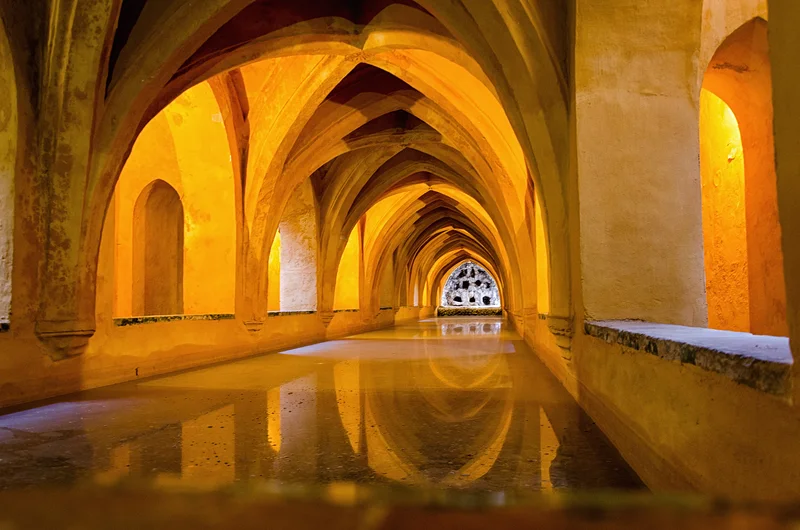
Drop your bags at the hotel and head out on foot: you will not need a car until the third morning, when you leave Seville.
The Alcázar is the royal palace of Seville, built by the Moorish kings and enlarged by the Christian ones, and still the residence of the king of Spain when he is in town: you will walk through arcaded patios, halls with gilded wooden ceilings and gardens with pools where peacocks roam.
Allow two hours, and choose one of the last afternoon slots on your ticket, the least crowded.
The cathedral next door, the largest Gothic church in the world, closes around 5pm: visit it before the Alcázar. You will see the tomb of Christopher Columbus and the gilded altarpiece, then climb the Giralda, the former minaret turned bell tower: 35 ramps with no steps, designed to be ridden up on horseback, take you 230 feet (70 m) above the rooftops. One ticket covers both; it is closed on Sunday mornings, during Mass.
Wander through Santa Cruz without a map, the old Jewish quarter pressed against the Alcázar: go by plaza de Doña Elvira and its orange trees, and calle Agua along the walls, and peek at the patios behind the iron gates.
For dinner, have tapas standing at Bodega Santa Cruz (calle Rodrigo Caro 1), noisy and cheap, or sit down at Casa Román (plaza de los Venerables 1) for Iberian ham; around 10pm, have a drink on the rooftop terrace of one of the hotels around the cathedral, facing the floodlit Giralda.
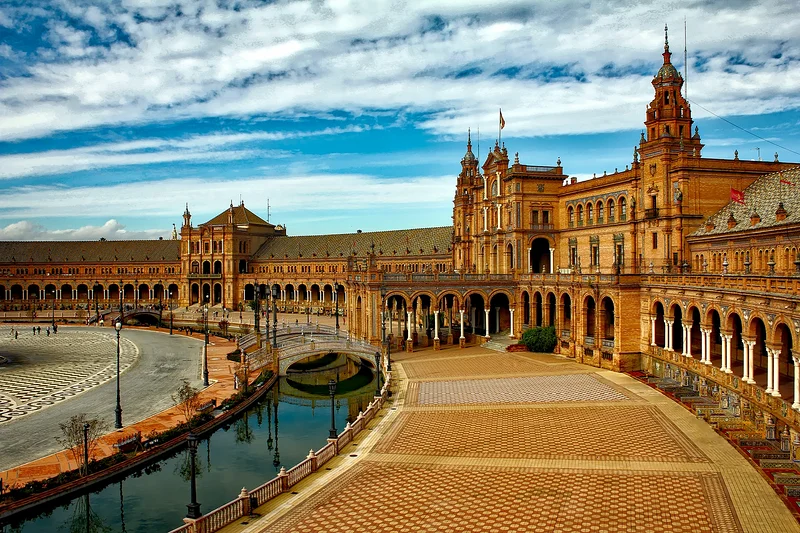
Set off on foot at 9am for the plaza de España, twenty minutes south of the cathedral: a half-circle of brick and painted tiles built for the Ibero-American Exposition of 1929, with a canal where you can rent a rowboat (about $6.60 for half an hour) and a tiled bench for each province of Spain.
Entry is free; before 10am, the tour buses have not arrived. Then spend an hour in the shade of María Luisa Park, right behind, under the palms and the jacarandas, in purple bloom in May.
Walk back along the Guadalquivir, Seville's river: the Torre del Oro, a 13th-century Moorish tower that guarded the port, houses a small naval museum and a terrace over the river. Have lunch five minutes away, at Casa Morales (calle García de Vinuesa 11), an 1850 tavern lined with huge earthenware jars: order the chorizo cooked in wine and the Manchego cheese.
Cross the Triana Bridge, the iron bridge of 1852, into Triana, the quarter of potters, sailors and flamenco on the west bank.
At the Triana Market (calle San Jorge 6), built on the ruins of the Inquisition's castle, eat tapas at the counter until 4pm. Then see the painted tiles that decorate the whole city in the ceramics shops of calle Alfarería and at the Centro Cerámica Triana, the ceramics museum (about $2.20, closed Mondays). Around 6pm, sit down at a terrace on calle Betis, the Triana riverfront facing the Torre del Oro.
For flamenco, choose a tablao, a small venue without dinner where the show lasts an hour: the Casa de la Memoria (calle Cuna 6, several shows a night, book the day before) or the Teatro Flamenco Triana (calle Pureza 76). Then have dinner at Las Golondrinas (calle Antillano Campos 26), a neighborhood bar with tiled walls: try the garlic mushrooms and the punta de solomillo, grilled pork tenderloin served on bread.
Pick up the car at 9am at Santa Justa station in Seville, where all the major rental companies have a desk, and leave the city eastward on the A-4 highway: for the first 25 miles (40 km), you cross the Guadalquivir plain, covered in sunflowers in June, then olive groves as far as the eye can see.
Carmona is thirty minutes away, a walled town on a hill above the plain: park below the Puerta de Sevilla, the double Roman and Moorish gate to the old town, climb to its alcázar for the view over the rooftops, then walk to plaza de San Fernando and its 17th-century houses. An hour is enough, a coffee on the square included; save lunch for Córdoba.
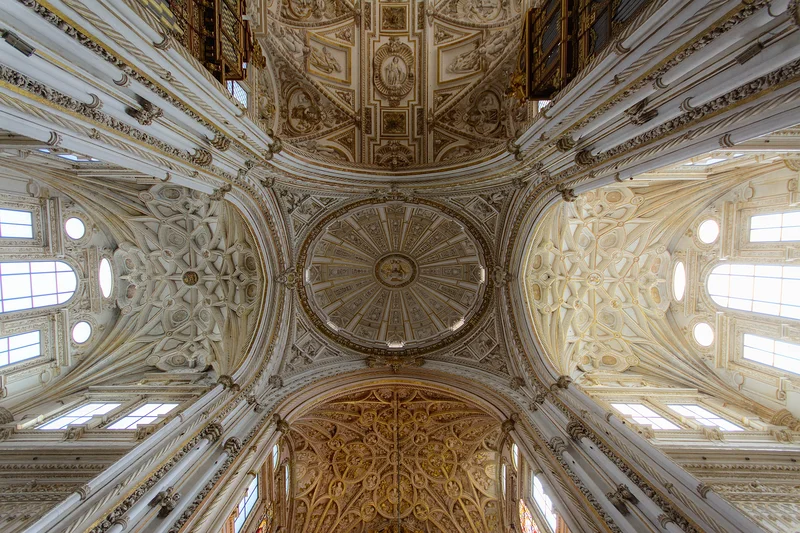
Córdoba is another 1h05 along the A-4. Leave the car in the hotel's parking or at Paseo de la Victoria, on the edge of the old town, and walk into the Mosque-Cathedral, the great mosque of the caliphs turned cathedral: you will walk among 850 columns of marble and jasper, under red and white arches, to the mihrab, the prayer niche covered in gold mosaics. In the middle stands a 16th-century cathedral.
Allow two hours. To see it without the groups, come back the next morning: Monday to Saturday, entry is free from 8:30am to 9:30am, before paid opening hours.
In the late afternoon, wander through the Judería, the medieval Jewish quarter around the mosque: go along the calleja de las Flores, the lane of geranium pots with the bell tower framed at its end, step into the 14th-century synagogue (free entry), and glimpse the flowered patios through half-open doors.
At sunset, cross the Roman Bridge: from the far bank, you see the Mosque-Cathedral reflected in the Guadalquivir. Have dinner at Taberna Salinas (calle Tundidores 3), a tavern dating from 1879: order the salmorejo, the cold soup of tomato and bread, and the flamenquín, the breaded pork roll.
If your Nasrid Palaces slot is at 4pm or later, start with Medina Azahara, the ruins of the 10th-century palace city of the caliphs, ten minutes west of Córdoba: a shuttle links the museum, at the bottom of the site, to the excavations (about $3.30 return; entry free for European Union citizens, about $1.70 for others; closed Mondays).
Allow two hours there. Otherwise, leave at 10am: Granada is 2h10 away on the A-45 to Antequera, then the A-92. After Loja, the last town before Granada, you will see the Sierra Nevada, the mountain range southeast of the city, snow-capped until May.
For the visit, park in the Alhambra parking lot, at the top of the hill (about $3.30 an hour), then drive down to the hotel. The center is closed to cars: use the parking garage your hotel recommends, most often San Agustín, near the cathedral.
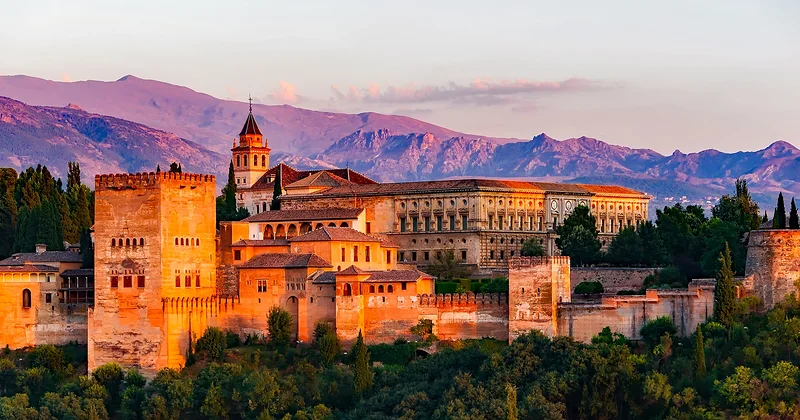
The Alhambra is the palace city of the Nasrid kings, the last Moorish kings of Spain, on a hill above the city. The visit has three parts: the Alcazaba, the fortress; the Nasrid Palaces, with their marble courtyards and stucco ceilings around the Court of the Lions; and the Generalife, the kings' summer garden, with its pools and cypress trees.
Allow three and a half hours. Your ticket carries a thirty-minute slot for the Nasrid Palaces: be at their gate ten minutes early, as you lose your entry if you arrive late.
Walk down the cuesta de Gomérez, the sloping street that links the Alhambra to the town, to the plaza Nueva, at the foot of the two hills: in the bars of the nearby streets, every drink comes with a tapa chosen by the owner, and three glasses add up to a dinner.
Go to Los Diamantes (calle Navas 28) for fried fish, then to Bodegas Castañeda (calle Almireceros 1), a short walk away, for ham and sweet wine from the barrel, served standing at the counter; these bars are packed from 8pm to 11pm.
Visit Granada's cathedral, five minutes from plaza Nueva, built over the great mosque after the Christians took the city in 1492: its nave is white and gold. Next door, in the Royal Chapel, Isabella and Ferdinand, the Catholic Monarchs, lie beneath marble effigies (two separate tickets, on the spot). Between the two, stroll through the Alcaicería, the old silk bazaar rebuilt as lanes of shops.
The Albaicín is the hill facing the Alhambra, the Moorish quarter from before the conquest: you will climb stepped lanes between white walls and cármenes, houses whose garden hides behind a gate.
Go up by calle Calderería Nueva, the street of Moroccan tea rooms, then keep climbing through whichever lanes you like; if you dislike stairs, take the C31 minibus from plaza Nueva (about $1.60). Have lunch at the Mirador de Morayma (calle Pianista García Carrillo 2), a restaurant in a carmen garden facing the Alhambra; book the day before.
East of the Albaicín, the Sacromonte is the quarter of Granada's Gypsies, who have lived since the 16th century in caves dug into the hillside, whitewashed and still inhabited.
Walk to the Museo Cuevas del Sacromonte in twenty minutes from the Paseo de los Tristes, the promenade along the Darro, the river that runs between the Albaicín and the Alhambra, following the Sacromonte path along the hillside. You visit eleven caves furnished as they were a century ago (about $5.50 per person), and you see the Alhambra across the ravine.
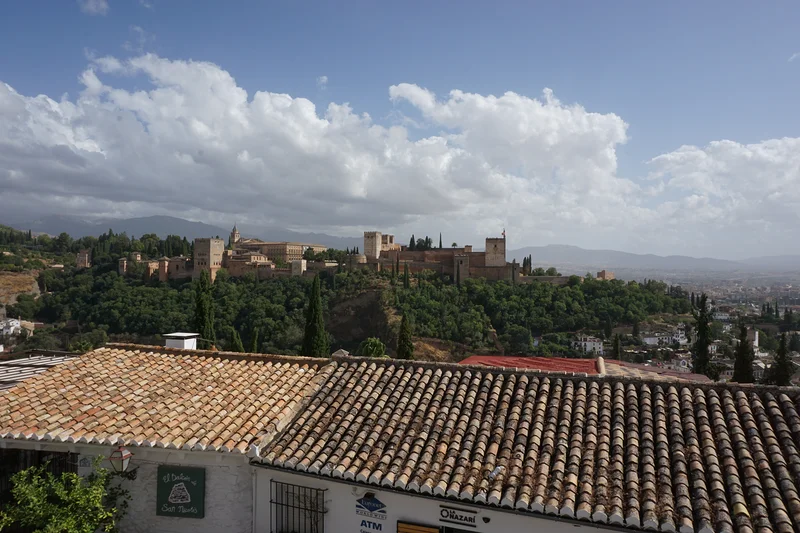
Climb to the Mirador de San Nicolás, the terrace in front of the church of the same name, at the top of the Albaicín, an hour before sunset: from there, you will see the whole Alhambra.
If the terrace is packed, climb fifteen minutes higher to the Mirador de San Miguel Alto, far less busy. In the evening, see a zambra, the Gypsy flamenco danced in a cave, at Cuevas Los Tarantos (camino del Sacromonte 9; book two days ahead).
Leave Granada at 9am on the A-92 heading west: Antequera is 1h10 away, a town of convents and bell towers at the foot of a rock shaped like a face lying down, the Peña de los Enamorados.
Park below the Alcazaba, the Moorish fortress, and climb up for the view (about $6.60 per person, with the collegiate church next door): stay an hour, no more, as the road is still long. The Menga dolmens, on the way out of town, are among the largest in Europe (free entry, closed Mondays): allow twenty minutes more.
Then take the A-384 toward Campillos: the fields give way to hills of olive trees, and Olvera appears after an hour, a white village rising in tiers below a castle and a church set on two rocks; stop at the lookout on the road, without driving into the village.
Setenil de las Bodegas, twenty minutes farther, is the strangest of the white villages: its houses are built under an overhanging cliff, and calle Cuevas del Sol runs beneath the rock. Have lunch in one of its bars, in the shade of the rock: order the chorizo and the mountain ham.
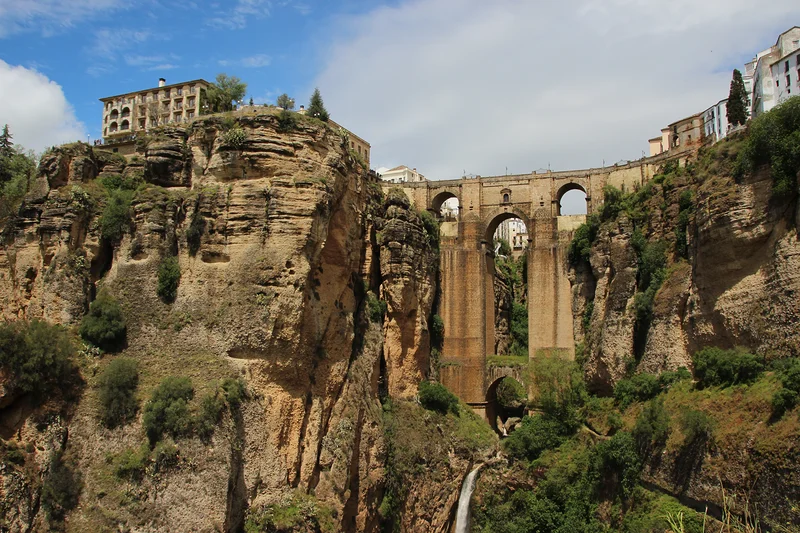
Ronda is thirty minutes from Setenil. Leave the car at the hotel or in the plaza del Socorro parking garage and walk to the Puente Nuevo, the bridge of 1793 that spans the Tajo, the 330-foot (100 m) gorge that splits the town in two; in the small room under the arch, an exhibition tells how it was built (about $2.80).
Then walk down through the Ciudad, the old town, to the Puente Viejo, the old bridge below, and the 13th-century Arab baths (about $5 per person), then climb back up. To see the bridge from below, take the path to the Hoya del Tajo lookout, under the bridge: a twenty-minute descent.
The Alameda del Tajo, the public garden on the edge of the cliff, has balconies hanging over the void: watch the sunset there, facing the serranía de Ronda, the mountain range to the west. Have dinner at Tragatá (calle Nueva 4), the tapas bar of the town's Michelin-starred chef, or at Casa María (plaza Ruedo Alameda 27), a small restaurant serving mountain cooking; book ahead.
Ronda's bullring, built in 1785, is among the oldest in Spain: visit it at opening time, when it is empty, with its bullfighting museum and its stables (about $11 per person). Allow an hour.
For a last view of the Tajo, visit the Casa del Rey Moro (cuesta de Santo Domingo 9, about $11), a house in the old town: from its garden, a staircase of more than two hundred steps, cut into the rock, leads down to the river at the bottom of the gorge.
Leave around noon on the A-397, the mountain road that winds down in forty-five minutes of bends to San Pedro de Alcántara, on the coast near Marbella: you will see the Mediterranean from the pass. Then take the toll-free A-7 east to Malaga. Allow 1h40 in all. In Malaga, leave the car in the hotel's parking or in the Alcazaba garage on calle Alcazabilla, on the edge of the pedestrian center.
The Alcazaba of Malaga, the fortress-palace of the Moorish governors, built in the 11th century, rises in terraces above the 1st-century Roman theater, uncovered in 1951 at the foot of its walls (free entry). You will walk through stepped gardens and patios with pools, with a view of the port from every gate. Allow 1h30; the ticket costs about $7.70 per person, or $11 with the Gibralfaro, to buy on the spot.
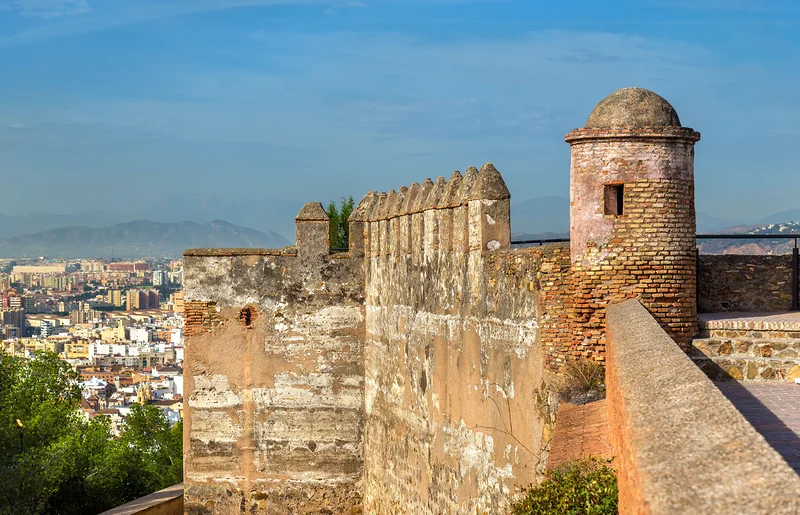
From the Alcazaba, walk up to Gibralfaro Castle on a twenty-minute paved path along the ramparts, steep but shaded in the afternoon. From the walkway on the walls, you see the whole city, Malaga Cathedral and its unfinished tower, the bullring, the port and, on a clear day, the coast of Africa.
Come back down the same way by 8pm, and have dinner at El Pimpi (calle Granada 62), the best-known bodega in town, whose barrels bear the signatures of famous visitors: try the sweet Malaga wine with fried fish. Without a reservation, wait for your table at the counter.
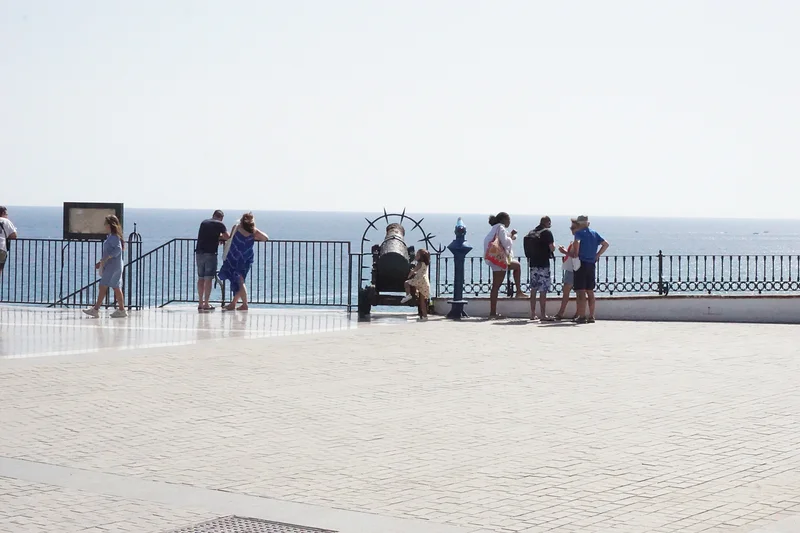
Leave at 9am: Nerja is fifty minutes from Malaga on the A-7 heading east, the last resort before the cliffs of the coast of Granada province.
Park in the underground garage nearby and walk to the Balcón de Europa, a terrace on a headland over the sea at the end of the old town, named by King Alfonso XII in 1885: on one side, you see the coves at the foot of the cliffs, on the other, the mountains of the sierra de Almijara. Have a coffee on the square.
The Nerja Caves, 2.5 miles (4 km) away, are a series of chambers hollowed out of the limestone, with one of the largest stalactite columns in the world, 105 feet (32 m) high: allow forty-five minutes for the marked route, and book the day before in summer.
Frigiliana, ten minutes up into the mountains, is a white village with lanes paved in pebbles: stay an hour, long enough to climb to the Barribarto, the Moorish quarter, and to have a glass of the sweet local wine.
Drive back down to Nerja for lunch on Burriana Beach, the largest in town, ten minutes on foot from the center: at Ayo, the best-known chiringuito (beach restaurant) on the coast, the paella cooks over a wood fire in enormous pans. Swim before or after.
For an evening flight, drive straight to Malaga Airport, about an hour from Nerja on the A-7 and then the MA-20, fifteen minutes west of the center: fill up at a gas station on the road to the airport, and return the car to the rental desks, which stay open late.
For a flight the next day, return the car that evening at the airport, ride the commuter train back to the center in twelve minutes, and spend the last evening on foot: visit the Picasso Museum (palacio de Buenavista, calle San Agustín 8, open until 7pm or 8pm depending on the season), then have a drink on a terrace on plaza de la Merced, where Picasso was born.
Choose where to pick up the car and your dates: rental companies' offers appear side by side.
Compare rental companies on Kayak in real time: Hertz, Avis, Europcar, Sixt and more.
Book a small car a month ahead, to pick up at Santa Justa station on the third morning rather than at the airport on arrival: you avoid paying two days of parking in Seville. When you book, choose the return at Malaga Airport, whose rental desks close late, and ask early for an automatic if you want one: there are fewer of them, and they cost more.
A credit card in the driver's name serves as the deposit; buy down the excess with the rental company or check whether your credit card covers it, as parking scrapes are common in the narrow streets of Córdoba and Ronda.
| Stop | Parking | Rate | On foot |
|---|---|---|---|
| Córdoba | Paseo de la Victoria, underground | ~$22 / day | 8 min. to the Mosque-Cathedral |
| Granada | Alhambra, for the visit | ~$3.30 / h | 5 min. to the ticket gate |
| Granada | San Agustín, underground | ~$28 / day | 5 min. to the cathedral |
| Antequera | Below the Alcazaba | Free | 5 min. to the fortress |
| Setenil | Village entrance | Free | 5 min. to calle Cuevas del Sol |
| Ronda | Plaza del Socorro, underground | ~$20 / day | 5 min. to the Puente Nuevo |
| Malaga | Alcazaba, calle Alcazabilla | ~$27 / day | 3 min. to the cathedral |
| Nerja | Balcón de Europa, underground | ~$2.20 / h | 2 min. to the Balcón |
Ronda, Setenil and Antequera have no zone closed to cars, but the streets of their old towns are too narrow: park at the edge. In Córdoba, Granada and Malaga, sort out parking with the hotel when you book the room.
Every road on this itinerary is toll-free: the A-4 on the third day, the A-45 and A-92 on the fourth, the A-92 then the A-384 and the small roads to Setenil on the sixth, the A-397 and A-7 on the seventh and eighth. Fill up in Granada before the sixth day: gas stations are scarce between Olvera and Ronda. From June to September, drive in the morning and park in the shade at every stop.
| What | For which day | What the itinerary needs |
|---|---|---|
| Alcázar of Seville | Day 1 | One of the last afternoon slots |
| Flamenco tablao in Seville | Day 2 | The day before, the first show so you can dine after |
| Car, Santa Justa station | Days 3 to 8 | A month ahead, return at Malaga Airport |
| Alhambra | Day 4 | A Nasrid Palaces slot after 3pm |
| Mirador de Morayma, Granada | Day 5 | The day before, a table on the terrace |
| Zambra at Cuevas Los Tarantos | Day 5 | Two days ahead |
| Ronda hotel on the gorge side | Night 6 | The first hotel to book: rooms with a view go fast |
| Nerja Caves | Day 8 | The day before in summer |
You can buy tickets on the spot for the other sights on the itinerary, the Mosque-Cathedral of Córdoba, Granada Cathedral, Ronda's bullring and the Alcazaba of Malaga; in spring, buy the Mosque-Cathedral ticket online a few days ahead.
| Item | Mid-range budget | With a little more |
|---|---|---|
| Car, 6 days | $220 to $330 | $440 with an automatic |
| Fuel, parking, return in Malaga | ~$165 | ~$250 with hotel parking |
| Hotels, 8 nights | $990 to $1,320 | $2,090 with the parador in Ronda and a palace hotel in Seville |
| Meals, 8 days | ~$610 | ~$880 with two chef's tables |
| Sights and shows | ~$220 | ~$310 with the caves and a guided tour of the Alhambra |
| Total for two | ~$2,310 | ~$3,960 |
In six days, skip Ronda and Nerja: from Granada, drive to Malaga in 1h30 on the A-92 and A-45 on the sixth day, and return the car that evening. You miss the Puente Nuevo and the white villages road; for seven days, keep Ronda and drop Nerja instead.
Add two nights in Cádiz after Seville, 1h20 away on a toll-free highway: the old town on its peninsula in the middle of the ocean, the beaches of La Caleta and La Victoria, and, on the way back, Jerez, with its sherry cellars and its royal school of equestrian art. Or spend a night in the Alpujarras, the white villages on the southern slopes of the Sierra Nevada, such as Capileira, 1h15 from Granada, before heading on to Ronda.
Follow the itinerary by train from Seville to Córdoba (45 minutes), from Córdoba to Granada (about 1h30) and from Granada to Ronda (2h30 to 3h, with one change), then by bus from Ronda to Malaga (about 1h45) and from Malaga to Nerja (1h). You give up Carmona, Antequera and the white villages, and you no longer have to look for parking in the evening.
If your flight lands in Malaga, do the itinerary in reverse: Nerja and Malaga first, then Ronda, Granada and Córdoba, and two nights in Seville, after returning the car at Santa Justa on arrival. The Alhambra then falls on the fourth or fifth day: choose your slot accordingly.
Andalusia
Pick your dates and see the offers from the major booking sites side by side.
Compare live offers from Booking, Expedia, Agoda and other partners.
Andalusia: find your hotel
From Seville if you arrive there by plane or by train: you spend the first two days without a car, and you end by the sea. From Malaga if flights there are cheaper: reverse the itinerary, and return the car at Santa Justa when you reach Seville.
With many of the big rental companies, a one-way rental between Seville and Malaga is free; with others, it costs $33 to $66. The fee shows up when you choose a different drop-off location at booking: compare it before you pay.
Swap days 4 and 5: leave Córdoba early on the fourth day to visit the cathedral and the Albaicín in the afternoon, and visit the Alhambra the next morning. You only miss Medina Azahara.
Yes, with shorter days: the sun sets around 6pm in December, so visit Carmona, Antequera and the white villages before 5pm, and be at the lookouts on days 5 and 6 around 5pm. The road from Ronda to the coast is safe all year round.