

D1 Day 1: the historic center, from the Archaeological Museum to the Duomo
- D1·1Archaeological Museum Museum
- D1·2Piazza Bellini Square
- D1·3Santa Chiara Church
- D1·4Cappella Sansevero Church
- D1·5San Gregorio Armeno Market
- D1·6Duomo Church

Naples fits into four days if each one keeps to its own ground: the Greek city and its lanes on the first, from the Cappella Sansevero to the Archaeological Museum; the royal city and the sea on the second, from the Teatro di San Carlo to the Castel dell'Ovo; Herculaneum and the crater of Vesuvius on the third; the Vomero heights and the Marechiaro sunset on the last. Two tickets are bought before you leave, Sansevero and Vesuvius; the rest is decided on the spot, between two lines outside a pizzeria.
© OpenStreetMap contributors
D1 Day 1: the historic center, from the Archaeological Museum to the Duomo
D2 Day 2: Toledo, the Plebiscito and the seafront
D3 Day 3: Herculaneum and the crater of Vesuvius
D4 Day 4: the Vomero, Posillipo and Marechiaro
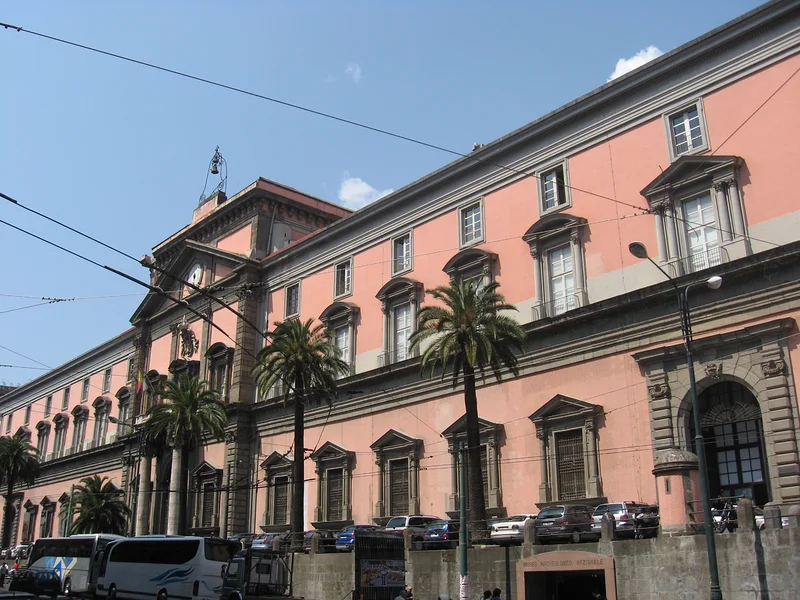
The Archaeological Museum opens at 9 a.m. Two and a half hours cover the essentials: the Pompeii mosaics on the first floor, including the Battle of Alexander, the Farnese marbles on the ground floor, and the Secret Cabinet, the room of erotic frescoes and objects from Roman villas, which draws a smile from many a couple.
Then walk down Via Santa Maria di Costantinopoli to Piazza Bellini, where a stretch of the Greek city walls shows beneath the square, and have a fried pizza for lunch at Di Matteo (Via dei Tribunali 94), eaten standing up.
The cloister of Santa Chiara, at the start of Spaccanapoli, lines up pillars and benches covered in yellow and green majolica tiles, shaded by lemon trees. Follow the street to the Cappella Sansevero at your booked slot: Giuseppe Sanmartino's Veiled Christ, a body lying under a marble shroud so fine it looks transparent. Allow forty minutes, then a babà at Scaturchio (Piazza San Domenico Maggiore 19).
Head up Via San Gregorio Armeno, the street of nativity workshops, open all year and packed in December, to the Duomo, the cathedral of San Gennaro, whose Treasury Chapel keeps the vial of the saint's blood.
Have an aperitivo on a terrace on Piazza Bellini, at Intra Moenia (Piazza Bellini 70), among students and booksellers. For dinner, give your name at the door of Gino e Toto Sorbillo (Via dei Tribunali 32) and wait your turn in the street: a margherita costs under $11, and the evening carries on through the lanes on foot.
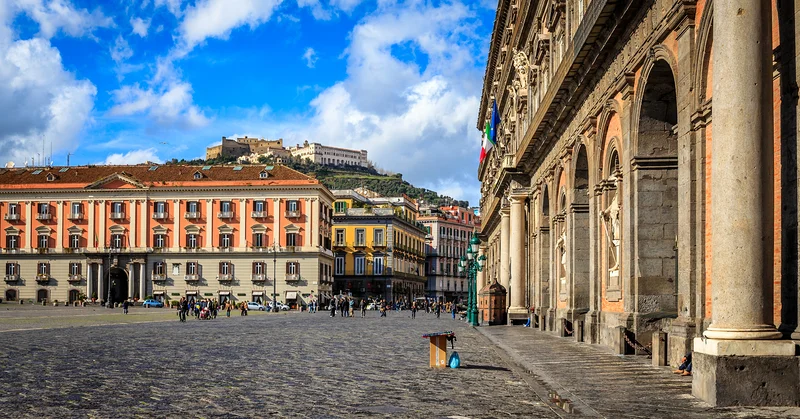
Start with a warm sfogliatella at Sfogliatella Mary, at the entrance to the Galleria Umberto I (Via Toledo 66), the late 19th-century shopping arcade under a glass dome. Across the street, the Teatro di San Carlo, opened in 1737 and the oldest working opera house in Europe, can be seen on a forty-minute guided tour.
Then comes Piazza del Plebiscito, the great semicircular square facing the Royal Palace, and an espresso standing at the counter of Gran Caffè Gambrinus (Via Chiaia 1), under its Belle Époque ceilings.
Walk back up Via Toledo and into the Spanish Quarter, the grid of steep lanes built in the 16th century to house the viceroy's soldiers: laundry on the balconies, street shrines, and the Maradona mural in the little square named after him. Lunch on fried bites and mozzarella from the stalls of the Pignasecca market, at the top of the quarter.
Head down to the sea along Via Chiaia and Via Partenope to the Castel dell'Ovo, the castle set on a tiny island, and watch the sun go down from the breakwater of Borgo Marinari, the little fishing harbor at its foot. Have a seafood dinner by the harbor at La Bersagliera (Borgo Marinari 10).
For a last drink, follow the seafront to Chiaia: the wine bars of Vico Belledonne stay open late, and Neapolitans drink standing in the street.
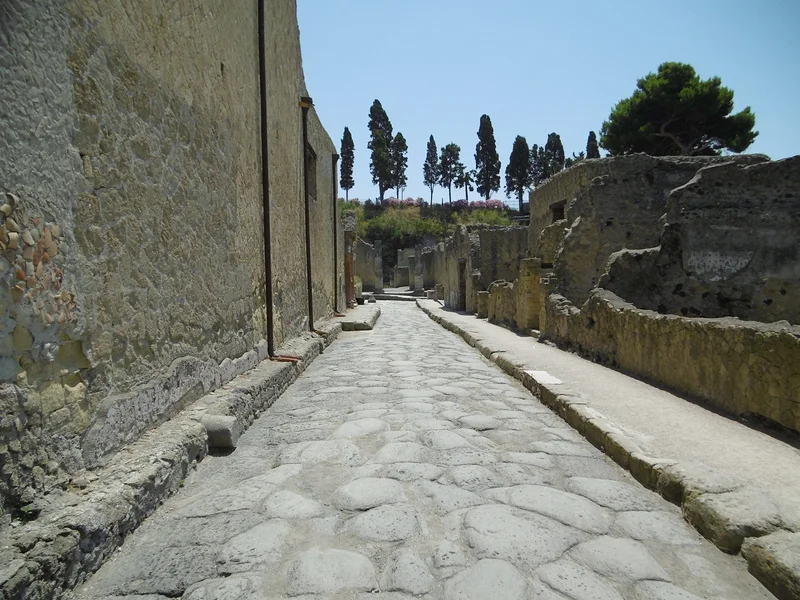
Take the Circumvesuviana from the Piazza Garibaldi station to Ercolano Scavi (~20 min), then walk ten minutes downhill to Herculaneum, which opens at 8:30 a.m. Smaller than Pompeii, it is better preserved: two-story houses, beams and doors of carbonized wood, intact mosaics. Two and a half hours are enough; finish at the old boathouses on the ancient shoreline, where three hundred skeletons were found.
Outside Ercolano Scavi station, Vesuvio Express shuttles climb to the volcano's parking lot, at 1,000 m (3,300 ft), in forty minutes. From there, a thirty-minute trail of volcanic ash leads to the rim of the crater of Vesuvius, with the whole bay below, from Naples to the Sorrento peninsula. The timed crater ticket is bought online the day before at the latest.
Take the train back around 5 p.m., shower, then head up to Materdei, a working-class neighborhood above the Archaeological Museum, for the fried pizza at Starita (Via Materdei 27), the pizzeria from Vittorio De Sica's film The Gold of Naples. Get back by taxi or from Materdei metro station.
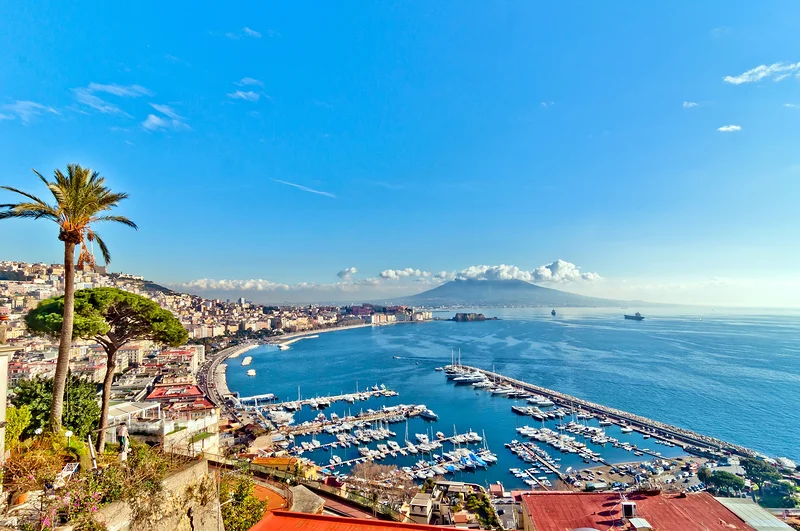
The Centrale funicular, which starts on Via Toledo, climbs in five minutes to the Vomero, the residential neighborhood on the hill. A ten-minute walk takes you to Castel Sant'Elmo, a star-shaped fortress whose terrace runs right around the city, from Vesuvius to Posillipo. Just below, the Certosa di San Martino, a former charterhouse, holds 18th-century Neapolitan nativity scenes and a garden terrace above the bay.
Lunch on a paper cone of fried bites at Friggitoria Vomero (Via Domenico Cimarosa 44), steps from the funicular.
Ride down on the Chiaia funicular and cross the Villa Comunale gardens to the harbor of Mergellina, where boats leave for the islands. Bus 140 then follows Via Posillipo, lined with villas, to Parco Virgiliano, a park at the tip of the headland with a view of the islet of Nisida, Procida and Capri.
Go down by taxi, or twenty-five minutes on foot, to Marechiaro, a fishing hamlet below Posillipo, with its little flower-decked window above the water made famous by a Neapolitan song. The sun sets facing Capri; afterwards, have a seafood dinner on the terrace at Da Cicciotto (Calata Ponticello a Marechiaro 32), booked the day before.
Pizza comes without a reservation and with a line; everything else is booked the day before on weekends. The historic pizzerias are in the historic center, seafood is on the waterfront and at Marechiaro.
Via dei Tribunali
Gino e Toto Sorbillo (no. 32) and Di Matteo (no. 94) for pizza and fried pizza; L'Antica Pizzeria da Michele (Via Cesare Sersale 1), a menu of just a few pizzas, since 1870.
Materdei and the Sanità
Starita (Via Materdei 27) for fried pizza, Concettina ai Tre Santi (Via Arena della Sanità 7 bis) for a neighborhood pizza in the Sanità, a working-class quarter north of the center.
Mergellina
50 Kalò (Piazza Sannazaro 201/B), pizza made with carefully chosen flours and Campanian produce, steps from the island ferries.
Ragù
Tandem (Via Giovanni Paladino 51), in the historic center: ragù simmered for six hours, served on pasta or with bread to mop it up.
Seafood
La Bersagliera (Borgo Marinari 10) at the foot of the Castel dell'Ovo, Da Cicciotto at Marechiaro, on a terrace above the water.
Pastry shops
The babà at Scaturchio (Piazza San Domenico Maggiore 19), the sfogliatella at Sfogliatella Mary (Galleria Umberto) and at Attanasio (Vico Ferrovia 1), near the station.
Aperitivo time starts around 7 p.m., and the drink is often taken standing in the street, a spritz or a glass of Campanian white wine in hand.
| Where | For | Good to know |
|---|---|---|
| Gran Caffè Gambrinus, Via Chiaia 1 | Coffee under Belle Époque ceilings | Pricier sitting down than at the counter |
| Intra Moenia, Piazza Bellini | A drink on a terrace on the students' square | Busy until 1 a.m. |
| Vico Belledonne, Chiaia | An aperitivo standing in the street | Packed on Friday and Saturday after 9 p.m. |
| L'Antiquario, Via Vannella Gaetani 2 | Cocktails in a hushed bar, with jazz in the background | Small, book on weekends |
| Borgo Marinari | A spritz at the foot of the Castel dell'Ovo at sunset | Terraces of the harbor restaurants |
Teatro di San Carlo
Opera and ballet from fall to spring, in a red and gold hall with tiers of boxes rising to the ceiling.
Napoli Sotterranea
A guided tour of the Greek cisterns and tunnels dug beneath the historic center, 40 m (130 ft) down (Piazza San Gaetano 68).
Galleria Borbonica
A 19th-century royal tunnel under the Pizzofalcone hill, used as a shelter in the war, with vintage cars still parked inside (Vico del Grottone 4).
Jazz
Bourbon Street (Via Vincenzo Bellini 52), near Piazza Bellini, for live music most nights.
A Napoli match
At the Diego Armando Maradona stadium, in Fuorigrotta: a fervor worth seeing once; tickets are in your name, and ID is checked at the gate.
Neapolitan nightlife happens in the street more than in clubs: the lanes of Chiaia around Vico Belledonne for bars with a thirty-something crowd, Piazza Bellini and Largo San Giovanni Maggiore for a student crowd. In summer, the evenings move to the terraces of Posillipo and the seafront.
| Destination | How to get there | Travel time | Why go |
|---|---|---|---|
| Pompeii | Circumvesuviana to Pompei Scavi | ~40 min | A whole Roman town buried in ash, a day on its own |
| Procida | Fast boat from Molo Beverello | ~40 min | Pastel houses on the Corricella harbor, quieter than Capri |
| Capri | Fast boat from Molo Beverello | ~50 min | The Piazzetta, the Gardens of Augustus and the Faraglioni rocks |
| Amalfi Coast | Circumvesuviana to Sorrento, then bus or boat | 2h to 2h30 | Positano and Amalfi, better with a night there |
| Caserta | Regional train from the central station | ~40 min | The Bourbon royal palace and its 3 km (2 miles) of gardens |
Naples
Pick your dates and see the offers from the major booking sites side by side.
Compare live offers from Booking, Expedia, Agoda and other partners.
Naples: find your hotel
Two days are enough for the historic center, the Cappella Sansevero, the Archaeological Museum and the seafront out to the Castel dell'Ovo. You'll have to give up Herculaneum, Pompeii and Vesuvius: add a third day if you can.
Margherita and marinara pizza, fried pizza, sfogliatella and babà, the Sunday ragù and same-day buffalo mozzarella. Eat pizza in the historic pizzerias of the center, seafood at Borgo Marinari or Marechiaro.
Yes. Entry is by fifteen-minute slots, often sold out for the day in season: book one to two weeks ahead, and avoid Tuesdays, when it is closed.
The Circumvesuviana leaves from the Piazza Garibaldi station: Herculaneum in twenty minutes, Pompeii in forty. Vesuvius is reached by shuttle from Ercolano Scavi, with a crater ticket bought online the day before at the latest.
At Marechiaro, below Posillipo, facing Capri; from the breakwater of Borgo Marinari, at the foot of the Castel dell'Ovo; and from the terrace of the Castel Sant'Elmo, above the whole city.