





Luxembourg for couples: what to know before you go (2026)
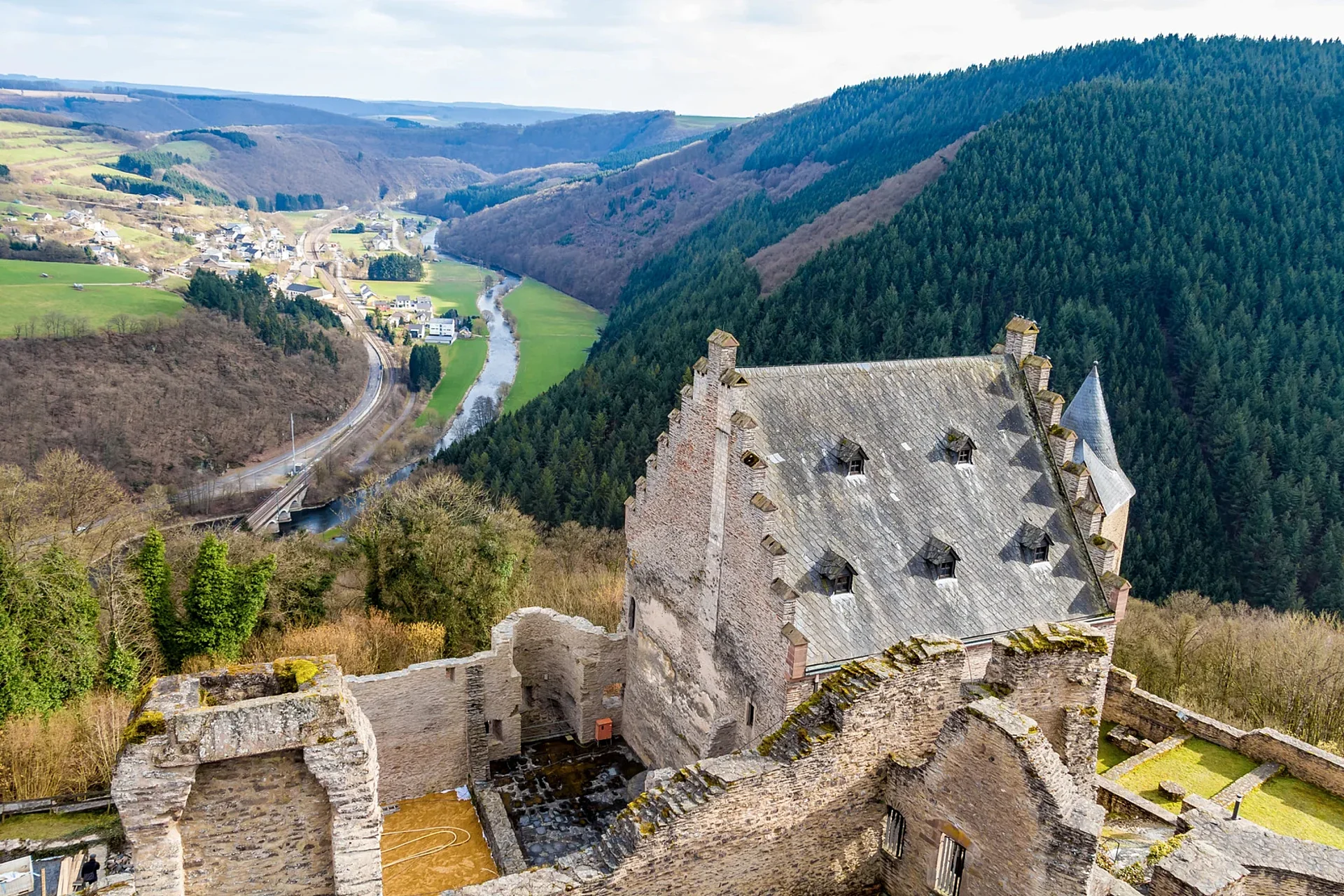
In Luxembourg, you pay nothing for the train, the bus or the tram: they are free across the whole country, in second class, for residents and visitors alike. You will not need a car in Luxembourg City or to reach the Moselle valley. For Vianden, the Mullerthal and the upper Sûre valley around Esch-sur-Sûre, rent one for two or three days: getting there takes one or two connections, and buses are scarce in the evening. Pick your season too: the Vianden chairlift only runs from Easter to mid October, and the solar boat on the Upper Sûre Lake from May to September.
At a glance
- When to go
- May to June and September: 17 to 23 °C (63 to 73 °F) in the afternoon, dry trails in the Mullerthal, and in September the grape harvest on the Moselle. From mid October to Easter, the Vianden chairlift is closed.
- How many days
- Allow two days for the capital, and five to add Vianden, the Mullerthal, the upper Sûre and the Moselle, with two hotels and a car for the last three days.
- Where to stay
- Sleep in Luxembourg City for the first nights, then in Vianden for the Ardennes and the Mullerthal; visit the Moselle from the capital or on your way back to the airport.
- Budget for two
- About $1,650 for four nights in comfort, hotels, meals and sights included, flights excluded; public transport costs you nothing, and a rental car adds $66 to $99 a day.
- A moment for two
- Walk the Chemin de la Corniche, the promenade along the old ramparts, at dusk, then go down on foot to the Grund, the district on the banks of the Alzette, for dinner.
- Book ahead
- The guided tour of the Grand Ducal Palace, from mid July to the end of August only: buy tickets as soon as sales open in spring, as summer dates sell out fast. Book Vianden hotels early too for a weekend from May to September.
Why Luxembourg for two
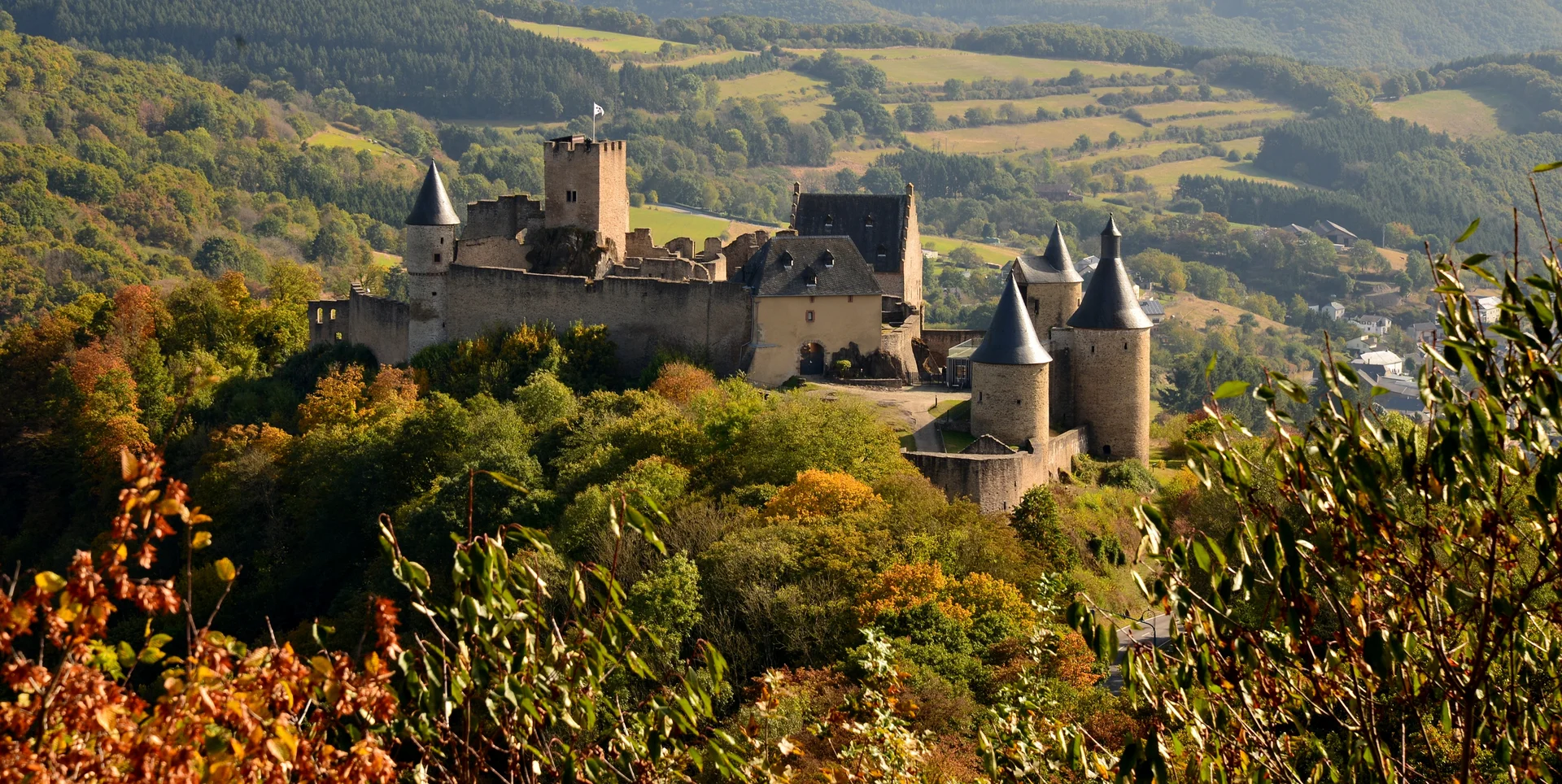
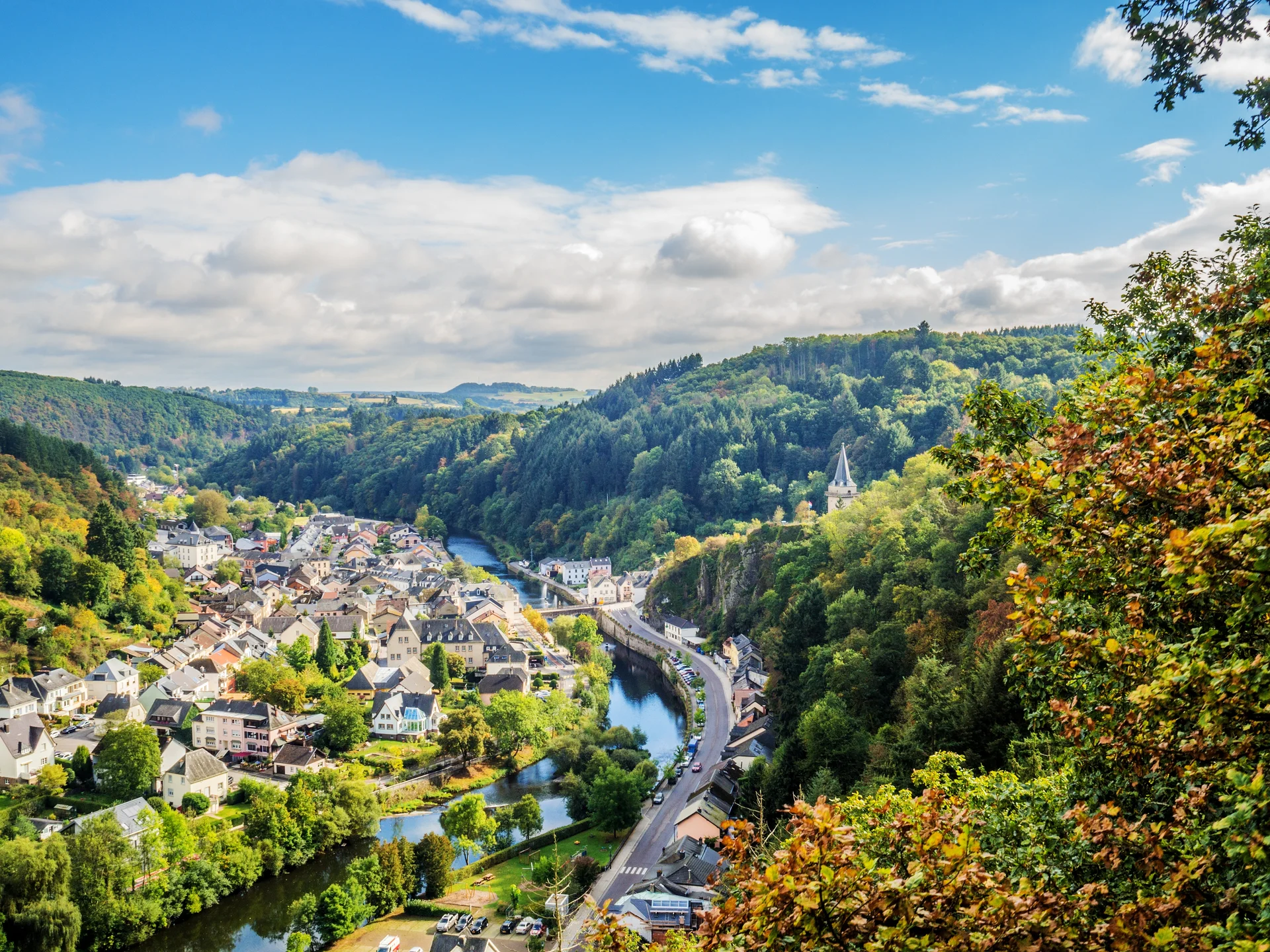
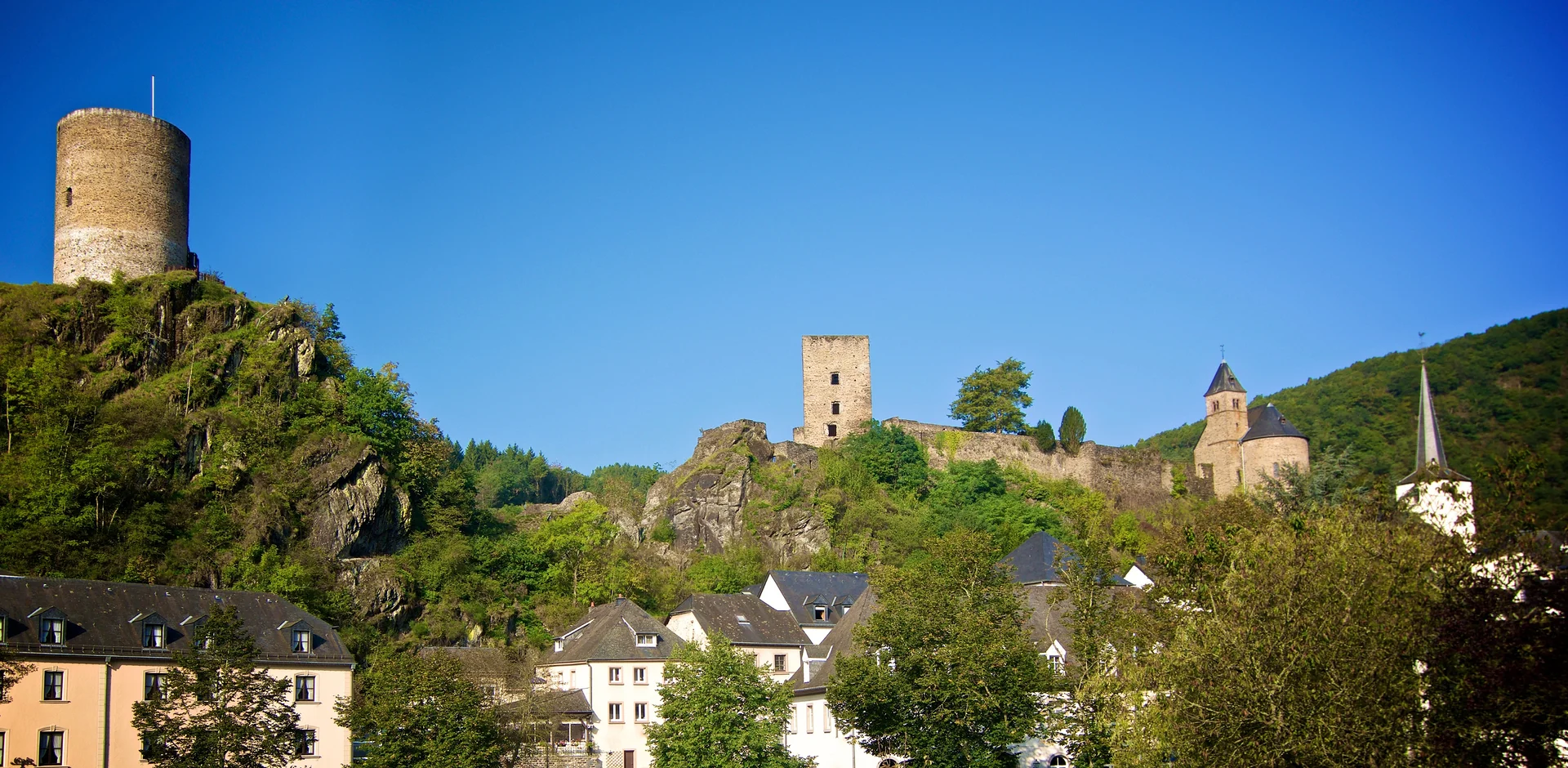
The country measures 82 km (51 miles) from north to south. In the north, the Luxembourg Ardennes, the Éislek, are a land of forests, deep valleys and castles on rocky spurs, at Vianden and Bourscheid. In the east, the Mullerthal is cut with sandstone gorges and passages so narrow you have to squeeze through sideways. In the southeast, the Moselle runs past slopes of vineyards facing Germany.
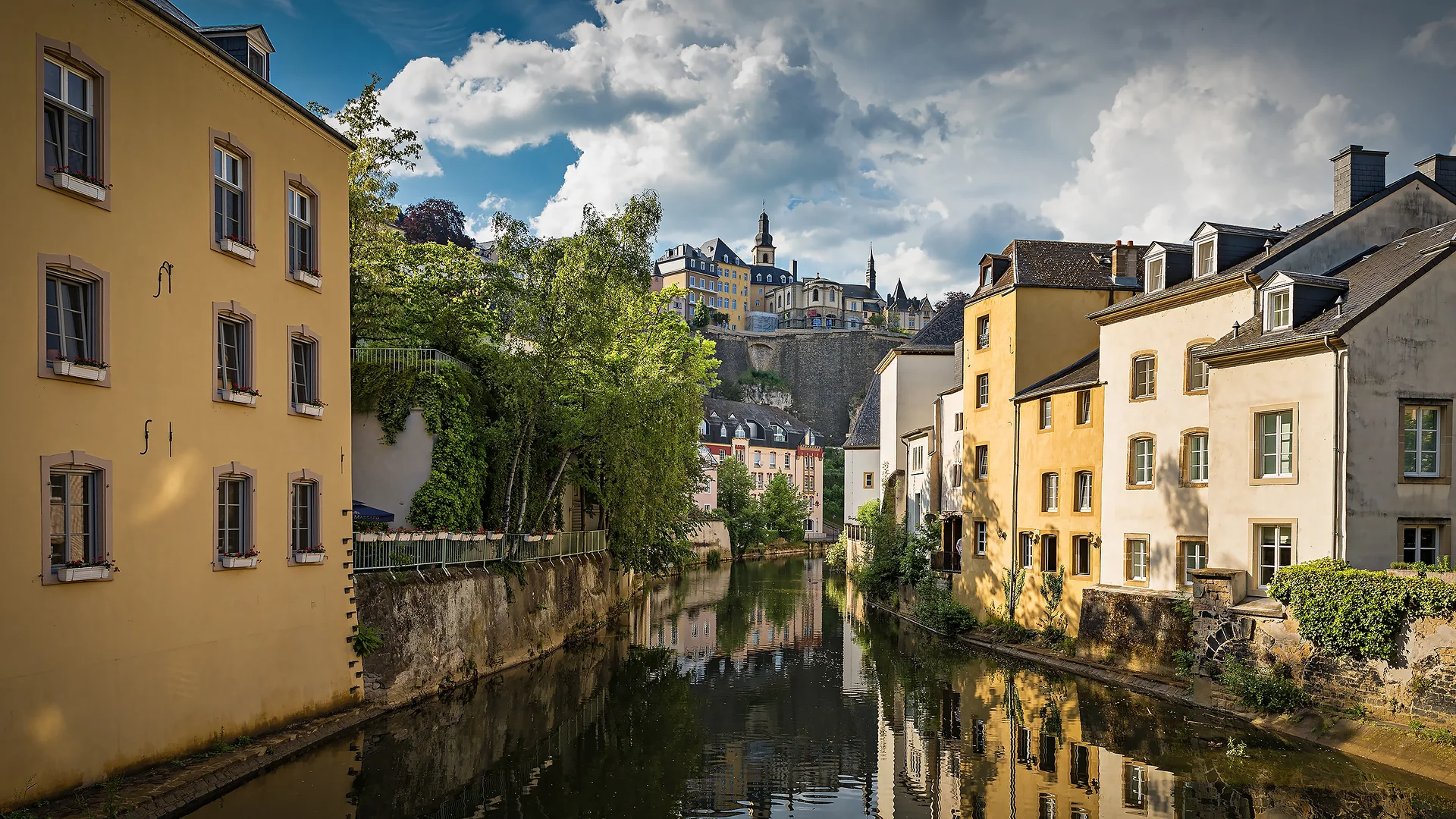
In the center, the capital is built on a rock above two valleys: you will have dinner down by the Alzette and ride an elevator back up. Between two places on the itinerary, you rarely drive more than an hour, so you can stay in the same hotel for two or three nights and take day trips.
When to go
| Period | Weather | Crowds | Our take |
|---|---|---|---|
| April and May | 12 to 19 °C (54 to 66 °F), frequent showers | Moderate, heavy on the Ascension and Whitsun weekends | Green forests, the Mullerthal in bloom, the Vianden chairlift running again |
| June to August | 20 to 25 °C (68 to 77 °F), storms late in the day | Heavy in Vianden and Esch-sur-Sûre on weekends | Café terraces, swimming in the Upper Sûre Lake, tours of the Grand Ducal Palace; book Vianden early |
| September and October | 12 to 20 °C (54 to 68 °F), cool mornings | Moderate, except on wine festival weekends | Our favorite: the grape harvest on the Moselle, the Éislek forests turning color |
| November to March | 1 to 7 °C (34 to 45 °F), gray skies, snow possible in the north | Low, except for the capital's Christmas markets | The capital lit up in December, but the chairlift closed, no swimming or boat on the lake, and short days |
Four dates come back every year. On June 23, the country celebrates its National Day, and on the evening before, fireworks go off above the Pétrusse valley, below the old town. In late August and early September, the Schueberfouer, the capital's big funfair, sets up on the Glacis, in the Limpertsberg district.
On Whit Tuesday, thousands of pilgrims hop through Echternach, the small town of the Mullerthal, to the sound of brass bands: this is the dancing procession. On the second Sunday of October, the Vianden nut market fills the Grand-Rue, the main street.
Paperwork: passport, visa, health
| Documents | Visa | Health | |
|---|---|---|---|
| United States, Canada | Passport valid at least 3 months after you leave the Schengen area, issued within the last 10 years | None for stays up to 90 days | Travel insurance with medical cover |
| United Kingdom | Passport valid at least 3 months after you leave the Schengen area, issued within the last 10 years | None for stays up to 90 days in any 180 | Your free GHIC covers state healthcare in Luxembourg; travel insurance for the rest |
| Ireland | Passport or passport card in date, asked for at the hotel | None | Free EHIC for public healthcare |
Entering the Schengen area from the US, Canada or the UK
On your first entry into the Schengen area, border police record your fingerprints and a photo (the EES system), so passport control takes longer: allow extra time if you connect through Frankfurt, Paris or Amsterdam. Check before you leave whether the ETIAS travel authorization is required on your dates: you apply for it online on the European Union site (travel-europe.europa.eu).
Getting there
By plane or by train
| From | Time | Good to know |
|---|---|---|
| London | ~1h15 | Nonstops from London City, Heathrow and Stansted: Luxair, British Airways, Ryanair |
| Manchester, Edinburgh, Dublin | 1h30 to 1h50 | Luxair nonstops from all three; Ryanair also flies from Dublin |
| London (St Pancras) | ~5h30 | Eurostar to Brussels, then a direct train to Luxembourg station |
| New York, Boston, Chicago, Toronto, Montreal | 9h to 12h with a stop | One stop in Frankfurt, Paris, Amsterdam or Zurich, or a flight to Paris then the TGV in 2h10 |
| West Coast | 13h to 16h with a stop | One stop in Frankfurt, Paris or Amsterdam; a night flight lands in Europe in the morning |
Luxembourg Airport (LUX), at Findel, is 6 km (4 miles) from the old town and linked to it by tram, see "From the airport to your hotel". Free transport stops at the border: a train ticket from Paris or Brussels covers the whole trip to Luxembourg station.
By car
If you rent a car in Paris or Brussels, allow about 4 hours from Paris and 2h30 from Brussels. Driving is on the right, as in North America; if you drive on the left at home, in the UK or Ireland, give yourself a few miles to adjust. Leave the car in the hotel parking lot or a park and ride on the edge of the capital for the first two days: the tram takes you into the old town.
Practical things to know before you leave
Phone
US and Canadian plans charge roaming at full price, and most UK plans now charge for Europe too: turn on a travel pass or install a European eSIM before you leave. With an Irish plan, calls and data work as at home, Luxembourg being in the European Union. In the Our and Sûre valleys, the signal drops at the bottom of the gorges: download an offline map.
Outlets and voltage
Outlets take the round two-pin plugs of continental Europe (types C and F), at 230 volts. American, Canadian, British and Irish plugs do not fit: bring one adapter per person. North American 110-volt appliances only work if they are dual voltage, which is the case for phones and laptops, rarely for hair dryers.
Money and tipping
- The euro, and cards accepted everywhere, even for a coffee; keep a few coins for paid restrooms at the sights and for small markets.
- Service is included in the bill and tipping is not expected at American levels: round up in a café, leave 5 to 10 % in a restaurant if the service was good.
- Decline the conversion into dollars or pounds that some card terminals offer: the rate is worse than your own bank's.
Languages
The country has three official languages, Luxembourgish, French and German. French is everywhere in writing, on signs and menus, and English is widely spoken in the capital, less so in the villages of the north. Say moien (hello) as you walk in, and merci (thank you), which Luxembourgish borrowed from French. Tap water is safe to drink.
What to book, and how far ahead
In Luxembourg, you will book few sights in advance: the only one that sells out is the Grand Ducal Palace, open to the public in summer only. Decide the rest the day before or on the spot. Only the hotels of Vianden and Esch-sur-Sûre, which are few, are full on weekends from May to September: book them one to two months ahead.
| Sight | Price / pers. | Book | Good to know |
|---|---|---|---|
| Grand Ducal Palace | ~$20 | A few weeks ahead | Guided tours from mid July to late August only, tickets online or at the city tourist office, Place Guillaume II |
| Bock Casemates | ~$15 | The day before | Open all year, entry by 15 min. time slot |
| Vianden Castle | ~$15 | On the spot | Open daily from 10am; arrive at opening time in July and August |
| Vianden Chairlift | ~$7.20 | On the spot | Easter to mid October, weather permitting |
| Bourscheid Castle | ~$7.70 | On the spot | Open all year, shorter hours from October to March |
| Caves St Martin, Remich | from $9.90 | A few days ahead | Guided tour of cellars dug into the rock, tasting included; Wednesday to Sunday, mid March to mid December |
| Solar boat, Upper Sûre Lake | from $5.50 | Booking required | 2h guided cruise, May to September, from Insenborn |
From the airport to your hotel
© OpenStreetMap contributors
The airport and the bases it serves
- Luxembourg Airport (LUX)
- 1Luxembourg City
- 2Luxembourg Central Station
- 3Vianden
- 4Remich
| Destination | Transport | Time | Typical fare |
|---|---|---|---|
| Luxembourg City | Tram, from the airport stop to the Hamilius stop | ~25 min. | Free |
| Luxembourg City | Taxi, outside the terminal | ~15 min. | $33 to $44 / taxi |
| Luxembourg Central Station | Tram, same line, to the Gare Centrale stop | ~30 min. | Free |
| Vianden | Rental car, picked up at the airport | ~45 min. | $66 to $99 / day |
| Vianden | Tram, train to Ettelbruck, then bus 181 | ~1h30 | Free |
| Remich | Rental car, picked up at the airport | ~25 min. | $66 to $99 / day |
What works best
For the capital, take the tram outside the terminal: with no ticket to buy or validate, it drops you on the edge of the old town, at the Hamilius stop, a five minute walk from Place d'Armes. A taxi only saves you ten minutes, for $33 to $44. If you land late, check the time of the last tram.
Getting around
Free trains, buses and trams
Across the country, you board a train, a bus or the tram without a ticket, in second class: there is nothing to buy or validate. Only first class on trains is still paid, from $3.30 a trip; an inspector will fine you if you sit there without a ticket. Plan your trips on the mobiliteit.lu website or app, which shows every connection.
The train links the capital to the north of the country via Ettelbruck, but Vianden, Echternach, Esch-sur-Sûre and Remich have no station: you finish by bus. For Vianden, take the train to Ettelbruck, then bus 181 via Diekirch: allow 1h to 1h15. In the evening and on Sundays, buses in the valleys are scarce.
In the capital, on foot and by elevator
You can cross the old town on foot in twenty minutes from end to end. To go down into the valleys, take the free public elevators.
The one at Plateau du Saint-Esprit drops you in the Grund, the district on the Alzette. The Pfaffenthal Panoramic Elevator, a glass cabin that drops 60 meters (200 feet) down the cliff, takes you to the Pfaffenthal, at the bottom of the northern valley, where a funicular climbs to the Kirchberg, the plateau of the European institutions.
By car
Speed limits are 50 km/h (31 mph) in built-up areas, 90 km/h (56 mph) on roads and 130 km/h (81 mph) on highways, 110 km/h (68 mph) in rain. In the Ardennes, roads are narrow and winding. In snow or ice, winter tires are compulsory: ask the rental company for them.
Budget for two
Luxembourg is one of the most expensive countries in Europe for hotels and restaurants, and public transport costs nothing. In the capital, hotels fill with business travelers during the week, so they are often cheaper from Friday to Sunday. What four nights for two cost, flights excluded:
| Smart | Comfort | Treat | |
|---|---|---|---|
| Hotel, per night | $121 to $165 (a simple hotel in Vianden, the capital on a weekend) | $198 to $280 (an old town hotel, a room with spa in the Ardennes) | from $500 (a Relais & Châteaux on Place d'Armes) |
| Meals, per day for two | $77 (a lunch special, a brasserie at night) | $143 (a simple lunch, dinner with Moselle wine) | $280 (a fine dining table) |
| Sights for the stay | $44 | $88 with a LuxembourgPass | $220 with the palace tour and a tasting |
| Transport for the stay | Free: train, bus and tram | $44 with a few taxis | $330 with a car for three days |
| Total, four nights | ~$940 | ~$1,650 | from $3,630 |
Useful benchmarks: a coffee $3.30 to $4.40, a lunch special $18 to $25, a Luxembourg beer $4.40 to $5.50, a glass of crémant $7.70 to $11, a bottle of Riesling bought at the winery $11 to $17.
Specialties to try
Luxembourg cooking is that of a country of forests and vineyards, between France and Germany: smoked pork, potatoes, game in the fall, river fish on the Moselle, and fruit tarts. You will taste it in village brasseries and Ardennes inns more than in the capital's restaurants.
To eat
-
Judd mat Gaardebounen
The national dish: smoked pork collar, served sliced with broad beans in cream sauce and potatoes. Order it in summer, when the beans are fresh.
-
Gromperekichelcher
Fritters of grated potato and onion, fried to order and sold three or four at a time at markets, village fairs and the capital's Christmas market.
-
Bouneschlupp
A thick soup of green beans, potatoes and bacon, often served with a smoked sausage: the lunch dish of Ardennes inns.
-
F'rell am Rèisleck
Pike in Riesling, cooked in a cream and white wine sauce: the specialty of Moselle restaurants, along with small fried river fish.
-
Kachkéis
A runny cooked cheese, spread on a slice of country bread with mustard: served as a starter or an afternoon snack in village cafés.
-
Quetschentaart
Damson plum tart, from late August to October, on a yeast dough and often served warm with whipped cream, in pastry shops and inns.
To drink
On the Moselle, try crémant de Luxembourg, the country's sparkling wine, and the dry white wines, Riesling, Auxerrois, Pinot Gris and Rivaner. The lagers of the Bofferding, Diekirch and Simon breweries are on tap everywhere. After dinner, order a plum or mirabelle brandy.
Customs and rules to know
Luxembourgers live in three languages and welcome hundreds of thousands of cross-border workers every day: you will be served in French or German everywhere, and in English in the capital. A few habits will spare you a closed door or a fine.
| Rule | What to expect |
|---|---|
| Smoking in a bar, a restaurant or an indoor space | Banned, with a fine; smokers step out onto the terrace |
| Driving after two or three glasses of crémant | Limit of 0.5 g/l, 0.2 for new drivers; frequent checks on the Moselle on wine festival evenings |
| Parking in a residents' space in the capital | A fine, and towing in the old town |
Outside the capital, restaurants serve from noon to 2pm and from 7pm to 9:30pm, much earlier than many Americans are used to, and many close on Mondays, sometimes Tuesdays too: book your dinner in Vianden or on the Moselle in the morning.
Safety
Luxembourg is one of the safest countries in Europe: you can walk back at night through the old town and the villages without worry. What you need to watch out for is mostly nature.
- The station district at night, around Rue de Strasbourg and Rue Joseph Junck: drug dealing and pickpockets. Cross it by tram rather than on foot after 10pm.
- The Mullerthal trails after rain: the sandstone turns slippery on the carved steps and in the narrow passages. Wear hiking shoes, not city sneakers.
- Ticks in the forests of the Ardennes and the Mullerthal, from April to October: long pants on the trails, and a check of your skin in the evening.
- The Upper Sûre Lake: swim only in the supervised areas of Insenborn and Lultzhausen, and read the sign at the entrance, which posts swimming bans when blue-green algae (cyanobacteria) bloom.
- Ardennes roads at nightfall: tight bends, fog in the fall, and deer crossing.
Mistakes to avoid as a couple
Most disappointments come from the same idea: thinking that such a small country can be seen in a day from the capital, driving from one parking lot to the next.
- Fitting Vianden, the Mullerthal and the Moselle into one day: you will spend four hours at the wheel to see three parking lots. Keep to one region a day, and spend at least two nights in the Ardennes.
- Renting a car on arrival to visit the capital: the old town is pedestrian, parking is expensive, and the tram takes you there for free.
- Confusing Esch-sur-Sûre, the Ardennes village in its river bend, with Esch-sur-Alzette, the country's second city, industrial, at the opposite end, near the French border.
- Counting on the bus to get back to Vianden or Esch-sur-Sûre for dinner after a day elsewhere: few run in the evening and on Sundays. Check the last departure on mobiliteit.lu before you set off in the morning.
- Planning the Vianden chairlift between mid October and Easter, or the solar boat on the lake outside the May to September season: neither one runs.
Luxembourg
Compare hotel prices
Pick your dates and see the offers from the major booking sites side by side.
Compare live offers from Booking, Expedia, Agoda and other partners.
Luxembourg: find your hotel
Frequently asked questions
How many days do you need in Luxembourg as a couple?
Two full days for the capital, its old town, the Corniche and the valleys below. Five days to add Vianden, the Mullerthal, the upper Sûre and the Moselle, with two nights in the capital and two in Vianden. With a week, add two nights on the Moselle.
Is public transport free for tourists too?
Yes. Trains, buses and the tram are free for everyone, residents or visitors, in second class, with no ticket or card to ask for. Only first class on trains and trips that cross the border are still paid.
Do you need to rent a car in Luxembourg?
Not for the capital or the Moselle, which the bus serves. Yes for two or three days if you want to see Vianden Castle, the Mullerthal gorges and Esch-sur-Sûre without waiting for connections: allow $66 to $99 a day, and pick it up at the airport as you leave the capital.
What is the best time of year for a couple?
September and early October, for the grape harvest on the Moselle, the Ardennes forests turning color and hotels that are easier to book. Then May and June, for dry trails in the Mullerthal and long evenings on café terraces.
Is Luxembourg an expensive destination?
For hotels and restaurants, yes: it is one of the most expensive countries in Europe. Allow about $1,650 for four nights for two in comfort, flights excluded, and $940 on a smart budget. Free public transport and capital hotels that are cheaper on weekends bring the bill down.
Do people speak English in Luxembourg?
In the capital, yes, in hotels, restaurants and shops; in the villages of the Ardennes and on the Moselle, less so: a few words of French help at the table. French and German are understood everywhere, and signs are in French.