

D1 Day 1: the cathedral, the Lonja and the Mercado Central
- D1·1Cathedral Church
- D1·2Plaza de la Virgen Square
- D1·3Lonja de la Seda Landmark
- D1·4Mercado Central Market
- D1·5Serranos Towers Landmark

Valencia is flat, and this plan makes the most of it: it is done on foot and by bike, with a tram or a bus only on day three. Day one stays in the old town, between the cathedral and its Holy Grail, the Lonja de la Seda and the Mercado Central; day two rides down the Turia Gardens to the City of Arts and Sciences. Day three follows the Valencian rhythm: Malvarrosa beach in the morning, paella at lunch, a boat on the Albufera at sunset. Day four, slower, is spent in the lanes of El Carmen, a glass of horchata in hand.
© OpenStreetMap contributors
D1 Day 1: the cathedral, the Lonja and the Mercado Central
D2 Day 2: the Turia Gardens by bike and the City of Arts
D3 Day 3: El Cabanyal, the beach and the Albufera
D4 Day 4: El Carmen, the Quart Towers and the Colón market
Start with the cathedral at opening time, around 10:30am: three doors from three eras, Romanesque, Gothic and baroque, and in a side chapel, the agate chalice that tradition presents as the cup of the Last Supper, the Holy Grail. Then climb the 207 steps of the Micalet tower for the rooftops and the sea in the distance.
Step out onto Plaza de la Virgen, the city's most beautiful square, with its Turia river fountain and the basilica of Our Lady of the Forsaken. On Thursdays at noon, the Water Tribunal sits in front of the Apostles' Door.
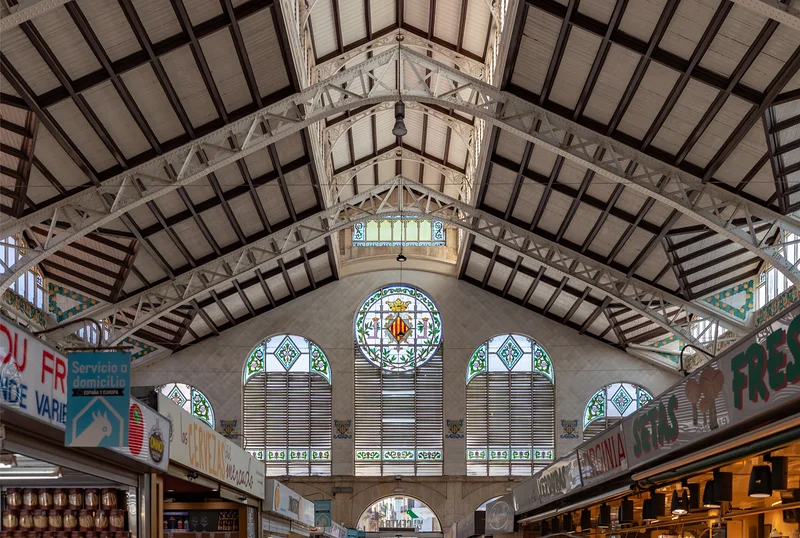
A five-minute walk leads to the Lonja de la Seda, the 15th-century silk exchange: a hall with columns twisted like palm trunks, and a courtyard of orange trees. Across the street, the Mercado Central, under its iron and glass dome, closes at 3pm: have lunch at the Central Bar counter inside the market, or grilled sardines at Tasca Ángel (Calle de la Purísima 1).
Go back for a siesta, then have horchata and fartons at Horchatería Santa Catalina (Plaza de Santa Catalina 6), open for more than two centuries, under its tiled walls.
Walk up to the Serranos Towers, the old north gate of the city, for the evening light over the Turia Gardens. Have dinner in El Carmen, with clóchinas, the small local mussels, at Bar Pilar (Calle del Moro Zeid 13), then a drink on one of the neighborhood's little squares.
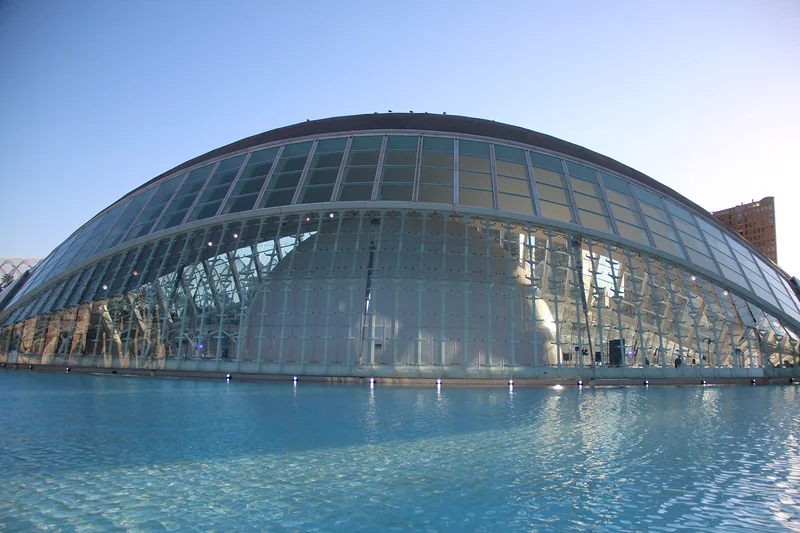
Rent two bikes near the Serranos Towers and ride down into the Turia Gardens, the old riverbed: a 6-mile (9 km) car-free path that runs under 16th-century stone bridges, past orange groves, fountains and sports fields. Allow twenty unhurried minutes to the end of the gardens.
The gardens end at the Hemisfèric, Santiago Calatrava's giant eye set on a pool, which opens the City of Arts and Sciences: the opera house, the palm-lined Umbracle, the science museum under its white arches. A loop around the pools takes an hour and costs nothing.
Have lunch on site, then head into the Oceanogràfic, Europe's largest aquarium, to walk through its tunnels under the sharks and see the belugas: three hours, with a ticket booked a few days ahead in summer.
Return the bikes and walk to Ruzafa, twenty minutes away, the restaurant neighborhood: a drink at the market, then dinner at Canalla Bistro (Calle Maestro José Serrano 5), chef Ricard Camarena's relaxed restaurant, booked a few days ahead, or in the tapas bars of Calle Sueca.
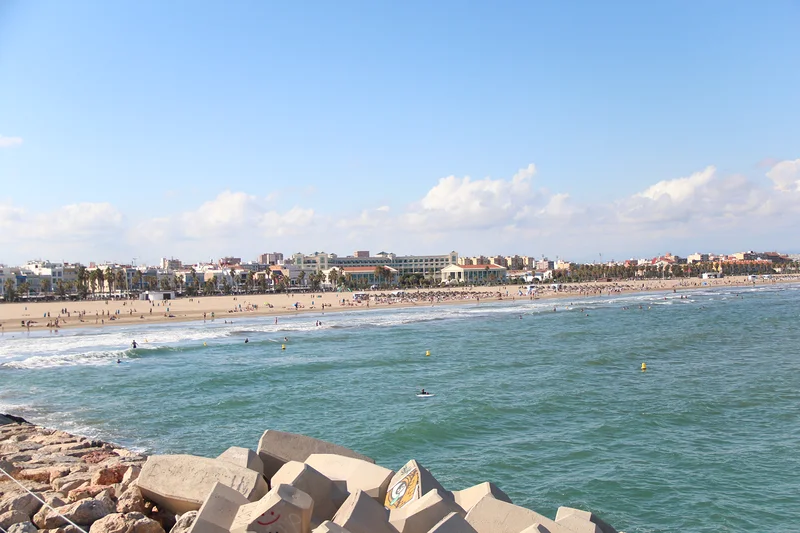
Take the tram to El Cabanyal, the old fishermen's quarter: straight streets of low houses with tiled facades, a covered market and neighborhood bars. At 11am, have a vermouth and anchovies at Casa Montaña (Calle Josep Benlliure 69), a wine bar opened in 1836, its walls lined with barrels.
Then walk to Malvarrosa beach, wide and more than half a mile long, and follow the promenade south to the restaurants of Las Arenas beach.
At 2pm, have a paella cooked over orange wood at Casa Carmela (Calle Isabel de Villena 155), two blocks from the beach, or a seafront paella at La Pepica (Paseo de Neptuno 6), on the promenade. Book, especially on weekends, and allow 25 minutes for the cooking.
Around 5pm in winter, 7pm in summer, take EMT bus line 25 or a taxi to El Palmar, the fishing village among the rice fields, 45 minutes away. At the jetty, a flat-bottomed boat takes you out on the Albufera lagoon, between reeds and fishermen's huts, to watch the sun go down over the water.
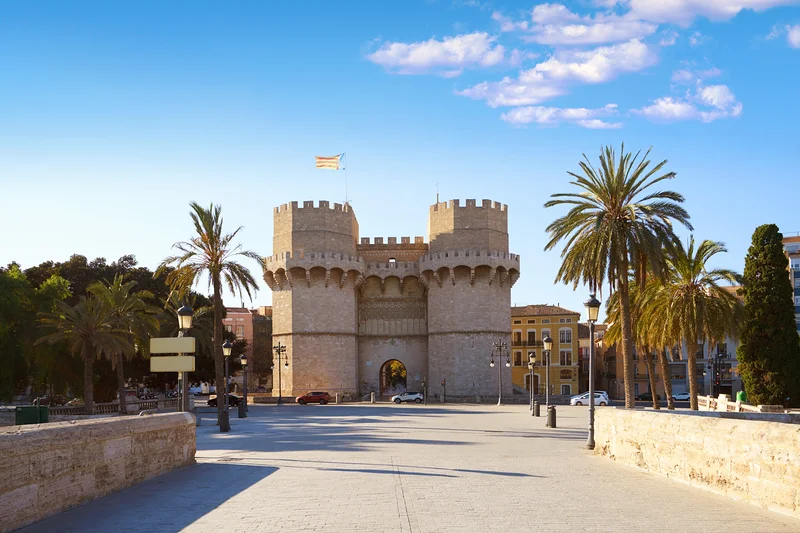
Begin at the Quart Towers, the western gate of the medieval walls, whose facade still bears cannonball scars from the Peninsular War: the climb to the top costs $2.20, and it is free on Sundays.
Then wander into El Carmen without a map: the murals of Calle Alta and Calle Baja, Plaza del Tossal, the little palm-shaded squares. The Centre del Carme, a former convent with two cloisters, hosts free contemporary art exhibitions.
Cross Plaza Redonda, a round square enclosed by buildings, where lace and fan shops still hold the arcades. Carry on to the Mercado de Colón, an Art Nouveau market from 1916 with orange-themed mosaics, now a hall of cafés and restaurants.
Order horchata and fartons at the Horchatería Daniel counter inside the market, then browse the shopping streets of the Eixample, around Calle Colón.
Head back to El Carmen for your last evening: tapas on a quiet street, then live jazz at Jimmy Glass (Calle Baja 28) or a drink on the terrace of Café Negrito (Plaza del Negrito 1).
In Valencia, the main meal is lunch: rice is eaten at 2pm, and evenings are for tapas. Book your weekend paella, especially on Sunday, when Valencian families order theirs.
Wood-fired paella
Casa Carmela (Calle Isabel de Villena 155, near the beach, lunch only) and La Pepica (Paseo de Neptuno 6, on the promenade for over a century); in El Palmar, Arrocería Maribel (Calle Francisco Monleón 5) for all i pebre and Albufera rice.
At the market
Central Bar, chef Ricard Camarena's counter in the heart of the Mercado Central, for a sandwich or a tapa before 3pm; the stalls of Ruzafa market for breakfast.
Old-town tapas
Tasca Ángel (Calle de la Purísima 1) for grilled sardines at the bar, Bar Pilar (Calle del Moro Zeid 13) for clóchinas and mussels, two neighborhood bars in El Carmen.
In Ruzafa
Canalla Bistro (Calle Maestro José Serrano 5), Ricard Camarena's global cooking at gentle prices, and the tapas bars of Calle Sueca and Calle Cádiz.
The El Cabanyal bocadillo
Bodega La Pascuala (Calle del Doctor Lluch 299), a neighborhood bar known for its giant bocadillos, to share at lunch.
The evening starts with horchata or vermouth and ends in El Carmen, in Ruzafa or on a terrace in summer.
| In the mood for | Where | Our take |
|---|---|---|
| Horchata | Horchatería Santa Catalina (Plaza de Santa Catalina 6), Horchata El Siglo (Plaza de Santa Catalina 11), Horchatería Daniel (Colón market) | Santa Catalina for its tiled rooms, with fartons |
| Agua de Valencia | Café de las Horas (Calle Conde de Almodóvar 1) | A baroque salon full of fresh flowers, steps from Plaza de la Virgen |
| Vermouth | Casa Montaña (Calle Josep Benlliure 69, El Cabanyal) | Before lunch, among the barrels |
| A drink outdoors | Café Negrito (Plaza del Negrito 1), the little squares of El Carmen | Negrito for its terrace under the trees |
| A drink in Ruzafa | Ubik Café (Calle Literato Azorín 13), the bars of Calle Sueca | Ubik, a bookshop café, to start the evening |
Opera at the Palau de les Arts
The Palau de les Arts Reina Sofía, at the City of Arts and Sciences, stages opera, ballet and concerts from October to June: an evening inside Calatrava's building, booked a month ahead for major productions.
Jazz
Jimmy Glass (Calle Baja 28, El Carmen), a jazz club with live musicians several nights a week.
A classical concert
The Palau de la Música, on the edge of the Turia Gardens, under its glass roof, hosts symphony concerts much of the year.
The Fallas
From March 15 to 19: the giant sculptures, the flower offering to the Virgin on the 17th and 18th, the nighttime fireworks and the cremà on the 19th, a night in the streets until dawn.
Summer terraces
From June to September, the Umbracle at the City of Arts and the terraces of the Marina, at the port, serve cocktails with music until the middle of the night.
Commuter trains leave from Estació del Nord, and Peñíscola is easier by car. The Albufera, the closest, has its place in day three.
Xàtiva, one hour by train
A castle over two hilltops, its ramparts and the view over the plain, then the old town and its fountains: take the little tourist train or a taxi up, and walk back down.
Sagunto, 30 minutes by train
A restored Roman theater and a castle running along the whole ridge, over half a mile of walls: half a day, finished before the heat in summer.
Peñíscola, 1h45 by road
A white old town on a rock above the sea, and the castle of Pope Luna: by car, for a day by the sea, or by train to Benicarló, then by bus.
The Albufera, 45 minutes by bus
The lagoon, the rice fields and El Palmar, for paella at lunch and a boat at sunset: day three of the plan.
Valencia
Pick your dates and see the offers from the major booking sites side by side.
Compare live offers from Booking, Expedia, Agoda and other partners.
Valencia: find your hotel
Two days are enough for the old town, the Mercado Central, the Turia Gardens and the City of Arts and Sciences. A third adds the beach and the Albufera; a fourth, El Carmen and the Colón market, or a day trip to Xàtiva.
In a restaurant that cooks it to order, over a wood fire when possible: in El Palmar, by the Albufera, or near the beach, like Casa Carmela. Order it at lunch, for two people minimum, and allow 25 minutes.
EMT bus line 25 leaves from the center and stops at El Palmar in about 45 minutes; a taxi takes 25. Coach tours including the boat ride also leave from City Hall square.
The outside, the pools and the Umbracle, yes, in an hour. With the Oceanogràfic, add three hours, and two for the science museum: pick one of the two, unless you travel with children.
Sunday for the Mercado Central, which is closed, and Monday for most museums. Sunday, on the other hand, is paella day and the day families stroll the seafront.