

D1 Day 1: the Vieux-Port, Le Panier and the MuCEM
- D1·1Vieux-Port Neighborhood
- D1·2Place de Lenche Square
- D1·3Vieille Charité Landmark
- D1·4La Major Cathedral Church
- D1·5MuCEM Museum
- D1·6Fort Saint-Jean Castle

In two days, you see the city: the Vieux-Port, Le Panier and the MuCEM on the first, Notre-Dame de la Garde and the Corniche out to the Vallon des Auffes on the second. You spend the next two days outdoors, on the calanques trails and then on the boat to the Château d'If and the Frioul islands: the mistral can cancel the boats or make hiking hard work, and summer heat sometimes closes the trails. Keep those two days interchangeable, and decide the evening before.
© OpenStreetMap contributors
D1 Day 1: the Vieux-Port, Le Panier and the MuCEM
D2 Day 2: Notre-Dame de la Garde, the Corniche and the Vallon des Auffes
D3 Day 3: the calanques, from Luminy to Sugiton
D4 Day 4: the Château d'If, the Frioul islands and Cours Julien
Start at the Vieux-Port around 8 a.m., at the fish market on the Quai des Belges, when fishermen sell scorpionfish and red mullet from their stalls. Walk under the Ombrière, the big mirrored canopy on the quay, then climb into Le Panier by the Montée des Accoules: the city's oldest quarter begins at the top of the steps.
Have a coffee on Place de Lenche, on the site of the Greek agora, then walk to the Vieille Charité, a 17th-century almshouse: the arcaded courtyard is free to enter, and so are the permanent collections of the two museums inside, except on Mondays, when they are closed.
Have a wood-fired pizza for lunch at Chez Etienne (43 rue de Lorette), a Le Panier pizzeria, then walk down to La Major Cathedral, striped in green and white stone, free to enter. The esplanade beside it leads to the MuCEM, the museum of Mediterranean civilizations, under its lattice of concrete; it is closed on Tuesdays.
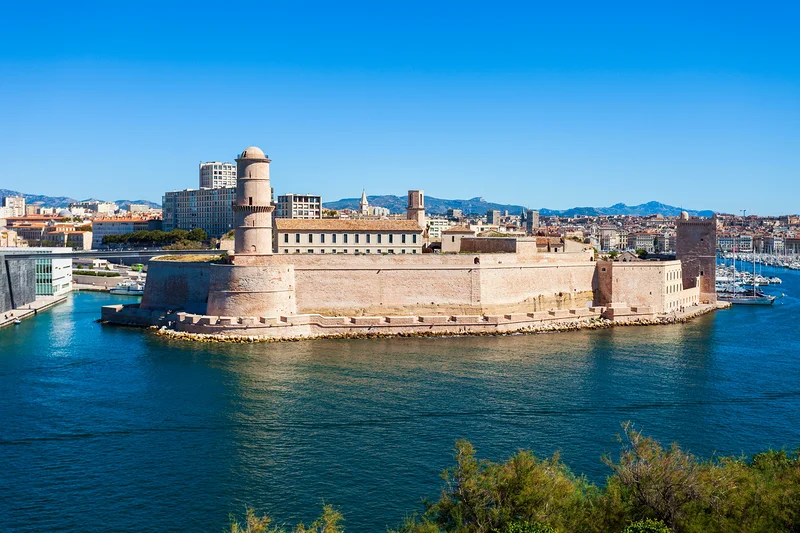
A footbridge links the museum's roof to Fort Saint-Jean, which has guarded the harbor entrance since the 17th century: its gardens and ramparts are free to visit during museum hours, with views of the harbor, the sea and Notre-Dame de la Garde.
Stay on the fort's ramparts until closing time, when the light turns the quayside facades golden, then have an aperitif on the balcony of La Caravelle (34 quai du Port), facing the basilica. For dinner, walk two minutes back up to the terraces on Place de Lenche, in Le Panier, quieter than those on the quay.
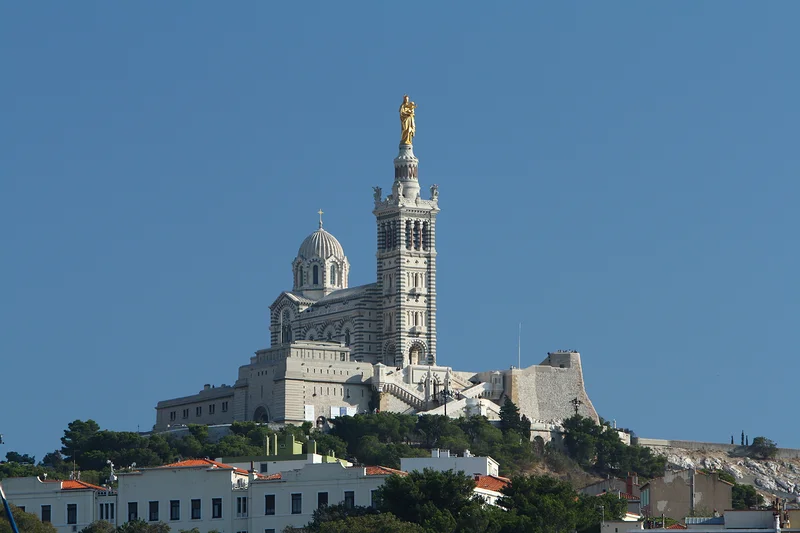
Buy a box of navettes, the orange-blossom cookies, at the Four des Navettes (136 rue Sainte), then step into Saint-Victor Abbey, just opposite: its 5th-century crypts are among the oldest Christian places of worship in France. Then ride bus 60 up to Notre-Dame de la Garde, which the locals call the Bonne Mère, the Good Mother.
The basilica, open from 7 a.m. and free, is covered in mosaics and sailors' ex-votos, with model ships hanging from the vaults. From the terrace, 150 m (490 feet) above the sea, you see the whole city, the Frioul islands and the calanques; cover your shoulders to go inside.
Walk back down toward the harbor, then head to the Pharo Gardens, on the headland of the palace built for Napoleon III: the lawn faces the harbor entrance and Fort Saint-Jean. Then take bus 83 along the Corniche, or walk half an hour by the water, to the rocks of Malmousque.
At Malmousque, the locals swim from the flat rocks and small coves, facing the Château d'If: bring water shoes and a towel, as there is no sand and no beach facilities. In a mistral, skip the swim and just follow the coastal path.
At sunset, walk down to the Vallon des Auffes by the stairs from the Corniche: the fishing boats are tied up under the bridge, and the sun goes down behind the islands. Have dinner on the little harbor, a bouillabaisse at Chez Fonfon or a pizza at Chez Jeannot (129 rue du Vallon des Auffes), both booked ahead, then ride bus 83 back.
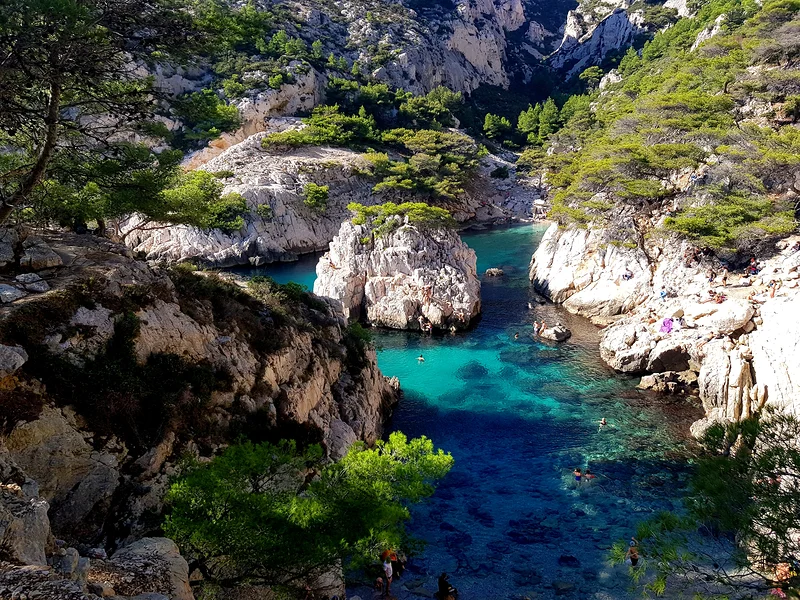
From June 1 to September 30, check the access map for the hills after 6 p.m. on the Mes Calanques app: on a red day, the trails of Calanques National Park are closed, and you switch to day 4. On days when the Sugiton booking applies, reserve your free access slot on the park's site, until 6 p.m. the day before.
Take bus B1 from Castellane before 8:30 a.m. to the end of the line, Luminy, on the university campus; bring two liters (half a gallon) of water each, a picnic and hiking shoes, as there is nothing to buy beyond. The trail climbs gently through the pines to a pass, then reaches the Sugiton viewpoint, where the calanque appears below you, between white cliffs.
The descent to the Sugiton calanque is steep at the end, with a few spots where you put your hands on the rock: allow an hour from Luminy. Swim from the rocks in very clear water, and settle in the shade of the pines before noon.
Start back around 2 or 3 p.m., when the trail gets a little shade again: the climb takes an hour and a quarter, in full sun toward the end. Back in town around 5 p.m., go to your hotel to shower and rest.
Have an aperitif at the Bar de la Marine (15 quai de Rive Neuve), facing the boats, then eat on Quai de Rive Neuve or the nearby streets, Rue Sainte and Place aux Huiles, with no more buses to catch.
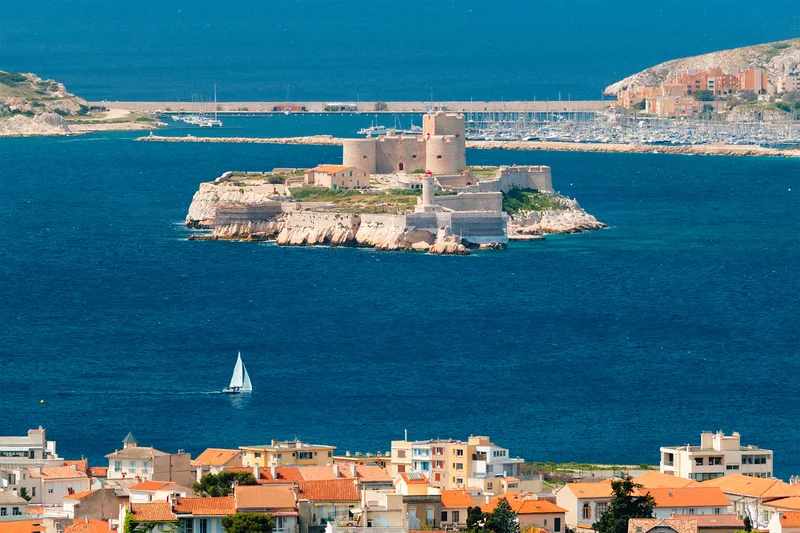
Take the first boat that stops at the Château d'If, around 10 a.m. from the Quai des Belges, with a ticket covering both the Château d'If and the Frioul: the crossing takes twenty minutes. The Château d'If, a 16th-century fortress on its rock, was once a prison; Alexandre Dumas locked up his Count of Monte Cristo there, and you can tour the cells in an hour, with an entry fee on top of the boat.
Board the boat again for the Frioul harbor, between the islands of Ratonneau and Pomègues, which a causeway joins together. Have lunch on the harbor, then walk across Ratonneau to the Hôpital Caroline, a 19th-century lazaretto where sailors were held in quarantine, and on to the nearby coves for a swim.
The islands have almost no shade: hats, sunscreen and water are essential. Come back on a 3 or 4 p.m. boat; the last departure changes with the season, so note it when you arrive.
Late in the afternoon, take metro M1 to Cinq-Avenues-Longchamp for the Palais Longchamp, its colonnade and its great fountain, built to celebrate the arrival of water from the Durance river. Then walk down, fifteen minutes, to Cours Julien, the district of painted facades, bars and small restaurants, for your last dinner.
The most Marseille of tables are by the water, at the Vallon des Auffes and on Quai du Port, with Le Panier for pizza. Book Thursday to Saturday dinners two days ahead, and have the plat du jour at lunch, around $17 to $22.
Bouillabaisse
Chez Fonfon (140 rue du Vallon des Auffes), on the little harbor, and Le Miramar (12 quai du Port), on the Vieux-Port: the rockfish soup, then the fish carved at the table, for two people at least.
A big dinner by the sea
Auffo (158 rue du Vallon des Auffes), Coline Faulquier's Michelin-starred restaurant at the end of the Vallon's jetty: a glass-walled dining room over the water and the islands, to book a week ahead.
Marseille pizza
Chez Etienne (43 rue de Lorette), in Le Panier, and Chez Jeannot (129 rue du Vallon des Auffes): a thin wood-fired crust, half anchovy, half cheese.
Catch of the day, at lunch
La Boîte à Sardine (2 boulevard de la Libération), a fishmonger that cooks its catch at lunchtime, near La Canebière, with a chalkboard menu that changes every day.
Ice cream and navettes
Le Glacier du Roi (4 place de Lenche), on the square in Le Panier, and the Four des Navettes (136 rue Sainte), which has baked its orange-blossom cookies since 1781.
Aperitif time starts around 6 p.m., with pastis on the harbor terraces; the bars on Quai de Rive Neuve and Cours Julien close around 1 or 2 a.m.
| In the mood for | Where | Our view |
|---|---|---|
| A pastis facing the boats | Bar de la Marine (15 quai de Rive Neuve) | A terrace on the harbor, open until 2 a.m. |
| A drink facing the Bonne Mère | La Caravelle (34 quai du Port) | A small balcony over the harbor, upstairs at the Hôtel BelleVue |
| An anise tasting | La Maison du Pastis (108 quai du Port) | Dozens of craft pastis to try |
| Sunset over the ferries | Les Terrasses du Port (9 quai du Lazaret) | A big free terrace facing the commercial port |
| A night of bar-hopping | Cours Julien and Place Jean-Jaurès | Beer and wine bars, a young crowd |
An opera or a ballet
The Opéra de Marseille (2 rue Molière), near the Vieux-Port, stages opera, ballet and concerts from fall to spring; tickets go on sale online several weeks ahead.
Theater on the harbor
The Théâtre de la Criée (30 quai de Rive Neuve), set in the old fish market hall, puts on plays all season, mostly in French.
An OM match
The Stade Vélodrome (3 boulevard Michelet) is home to Olympique de Marseille: plan a match night weeks ahead, with tickets on the club's site and metro M2 to Rond-Point du Prado.
Festivals
The Festival de Marseille, in June and July, brings dance and music all over the city; the Fiesta des Suds, in October, gathers world music on the J4 esplanade, at the foot of the MuCEM.
| Destination | Getting there | What for | Our view |
|---|---|---|---|
| Cassis | Regional train, ~25 min., then bus | The harbor, the calanques of Port-Miou and En-Vau, white wine | The prettiest; the station is 3 km (2 miles) from the harbor |
| Aix-en-Provence | Coach, ~40 min. | Cours Mirabeau, the fountains, the markets | In the morning, on a market day |
| Côte Bleue | Regional train, ~30 min. | The calanques of Niolon and Méjean, the fishermen's huts | The coast without the crowds, by train |
| Les Goudes | Bus 19 then 20, ~1h | The fishing village at the end of the road, the rocks | On weekdays, outside July and August |
| Avignon | TGV, ~35 min. | The Palais des Papes, the Pont d'Avignon | A full day |
Marseille
Pick your dates and see the offers from the major booking sites side by side.
Compare live offers from Booking, Expedia, Agoda and other partners.
Marseille: find your hotel
Yes for the city: the Vieux-Port, Le Panier and the MuCEM on the first day, Notre-Dame de la Garde, the Corniche and the Vallon des Auffes on the second. The calanques and the Frioul islands each need an extra day.
Take bus B1 to Luminy, then walk an hour to Sugiton; or board a three-hour cruise at the Vieux-Port. In summer, the roads to Sormiou and Morgiou are closed to visitors' cars.
Sugiton, for the bus access from Marseille and the very clear water; En-Vau, more spectacular, is easier to reach from Cassis, on a longer and steeper trail. In summer, set off early and check access the evening before.
Yes: one boat ticket covers both, the Château d'If in the morning, then the Frioul harbor, lunch and a swim in the afternoon. The mistral sometimes cancels the crossings: keep a spare day.
At the Vallon des Auffes and on the rocks of Malmousque, facing the Frioul islands, all year round. From November to January, go up to Notre-Dame de la Garde late in the afternoon: the sun sets before the site closes.