

D1 Day 1: the Old Town, from the Japanese Bridge to the lanterns
- D1·1Japanese Bridge Bridge
- D1·2Tấn Ký House Landmark
- D1·3Phúc Kiến Assembly Hall Landmark
- D1·4An Hội Night Market Market

You will see Hội An at its best at two moments: before 8am, when the Japanese Bridge is empty and the central market takes in the morning catch, and after 6pm, when the lanterns come on along the Thu Bồn. So this plan puts each big outing first thing in the morning (the gardens of Trà Quế, the Mỹ Sơn sanctuary, the Marble Mountains) and keeps every evening for the Old Town; in between, An Bàng beach or the pool. Order your clothes from a tailor on day one: the fittings will fall on days two and three.
© OpenStreetMap contributors
D1 Day 1: the Old Town, from the Japanese Bridge to the lanterns
D2 Day 2: the market, the Trà Quế gardens and An Bàng beach
D3 Day 3: Mỹ Sơn at dawn and the Thanh Hà pottery village
D4 Day 4: the Marble Mountains and the Bảy Mẫu coconut forest
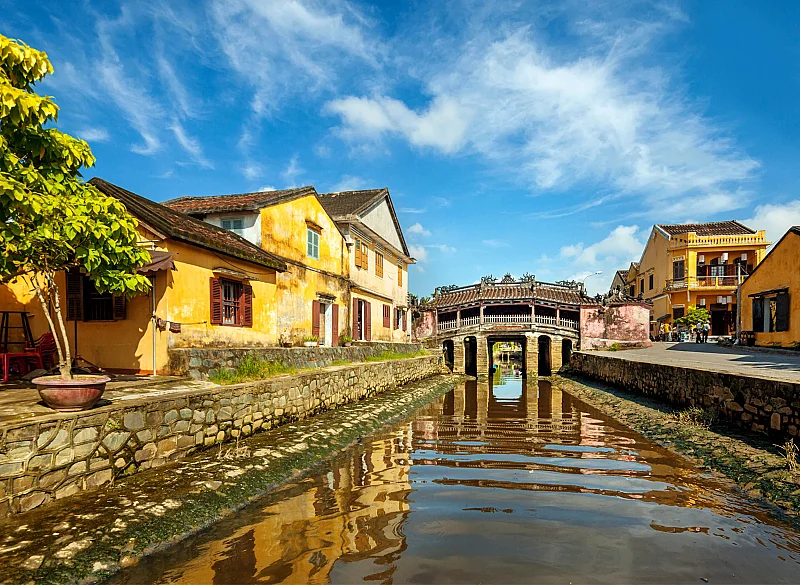
Buy the Old Town ticket at the first booth, then be at the Japanese Bridge before 7:30am. This covered bridge, built by the Japanese community about four centuries ago and recently restored, has a small temple on its north side; it appears on the 20,000 dong note. At this hour, you walk across without waiting in line.
Walk up Nguyễn Thái Học street to Tấn Ký House, an 18th-century merchant house where the same family has lived for seven generations: carved beams, an inner courtyard and the marks of the great floods, each with its year. Then stop by a tailor to order your clothes: the first fitting will be tomorrow.
Head back to your hotel around 11am: have cơm gà, the town's chicken rice, for lunch, then nap or swim. Come back at 4pm for the Phúc Kiến Assembly Hall, the meeting hall of the Fujian merchants on Trần Phú street: a ceramic gateway, a courtyard of pools and hanging incense coils.
At 6pm, the lanterns come on and the Old Town closes to scooters. Board a lantern boat for twenty minutes or so on the Thu Bồn (about $7.70 a boat, price agreed before you board), set a candle on the water, then cross the bridge to the An Hội Night Market, on Nguyễn Hoàng street, for a skewer and a sugarcane juice. Then have dinner on the riverbank.
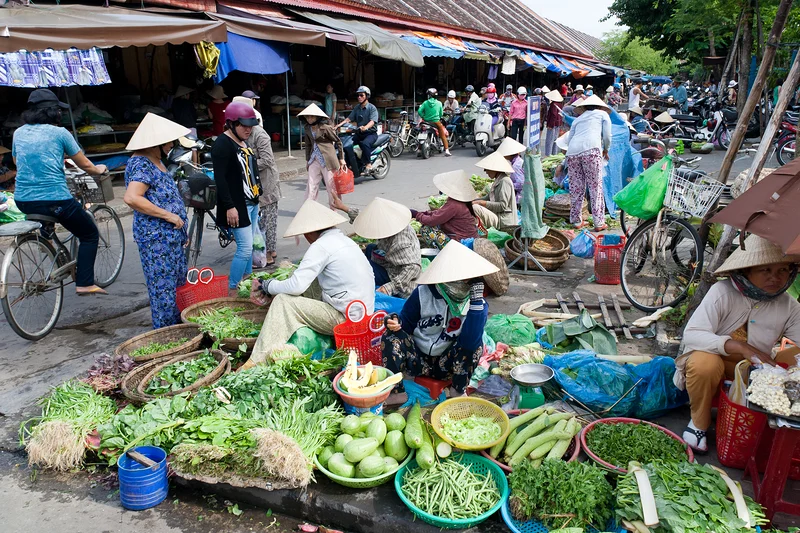
At 6:30am, the central market, on the riverbank, takes in fish from the boats and herbs from the gardens. Walk through it with the chef of your cooking class, booked two days ahead: most classes start here, then ride by bike or boat to the village of Trà Quế, 2 miles (3 km) north.
In this market-garden village, families have grown the town's basil, mint and cilantro for centuries, watered by hand and fertilized with seaweed from the nearby lagoon. You cook rice pancakes and spring rolls, then have lunch in the garden (allow $28 to $50 per person).
From Trà Quế, cycle on to An Bàng beach, 2 miles (3 km) along a road through the rice fields. Take two loungers in front of a restaurant for the price of a drink, and swim in front of the lifeguard station: from May to September, the sea is usually calm.
Have grilled fish and squid at one of the restaurants on the sand at An Bàng, for $22 to $39 for two, then ride back by Grab, with the bikes in the trunk if the driver agrees, or leave them at the restaurant. Stop at the tailor for the first fitting if the shop stays open late.
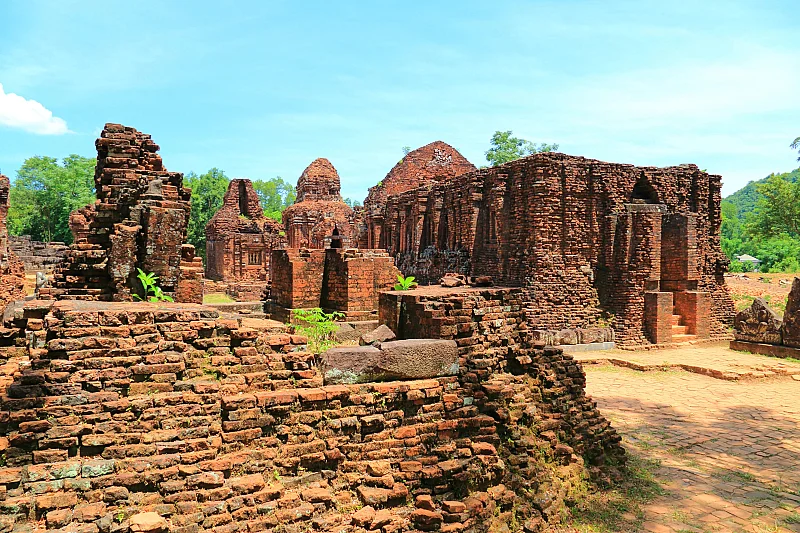
Leave at 5am in the car booked the day before, to reach the Mỹ Sơn Sanctuary when it opens, around 6am. In this valley ringed by hills, the kings of Champa, a Hindu kingdom of central Vietnam, built towers of carved brick from the 4th to the 13th century; wartime bombing destroyed much of it, and you can see the remaining groups in two hours.
An electric shuttle runs from the entrance to the temples, then you continue on foot along forest trails: closed shoes, water and repellent. Stay on the marked paths, and head back around 9am, when the tour buses arrive from Hội An and Đà Nẵng.
After lunch and a nap, cycle 2 miles (3 km) west to Thanh Hà, a riverside pottery village where families still throw clay by hand. The village entry ticket (about $1.10 per person) often includes a small piece shaped in front of you. Head back around 4:30pm for the second fitting at the tailor.
Cross the An Hội Bridge around 5:30pm to watch the sun drop behind the rooftops from the riverbank, then have dinner at a restaurant on Nguyễn Phúc Chu street, facing the lit-up Old Town. On the night before the full moon, stay on the bank: the electric lights go out and the river fills with candles.
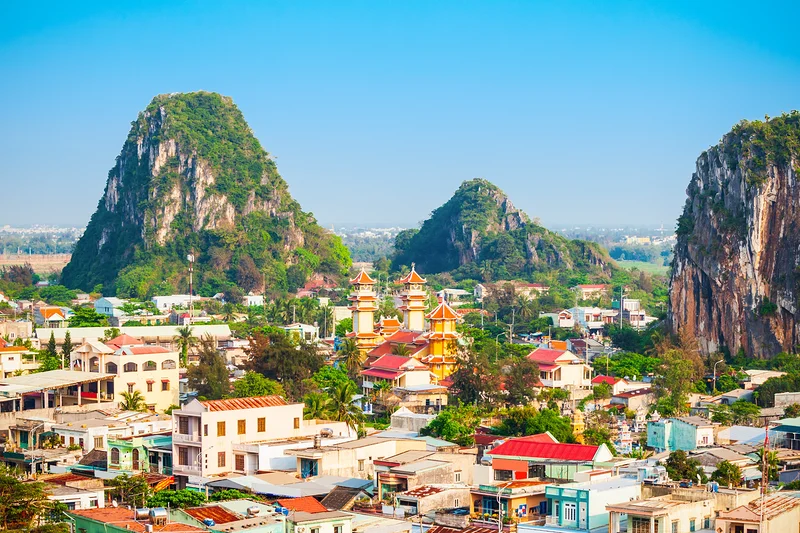
At 7am, a Grab takes you in half an hour to the Marble Mountains, five limestone and marble hills on the road to Đà Nẵng. Climb the highest one, Thủy Sơn, the Water Mountain, on foot or by elevator: pagodas and altars are tucked into the rock, and a lookout at the top has views over the beach and Đà Nẵng.
Go down into Huyền Không Cave, a tall cavern lit by openings in its roof, where Buddhas are carved into the wall: the light is best around 9am. Head back before 11am; the marble sculpture shops at the foot of the hills charge a lot and ship poorly.
Around 4pm, head to the Bảy Mẫu coconut forest, in Cẩm Thanh, where fishermen paddle you between the water palms in a round woven bamboo boat, the thúng chai. Allow half an hour; agree on the price before you get in, and pick a boatman without a loudspeaker, as some play loud music.
Pick up your clothes from the tailor, then keep the last evening for the Old Town on foot: a dinner of mì Quảng or white rose dumplings, and a last drink on a riverside balcony.
A street food dish costs $1.10 to $3.30, dinner for two at a good Old Town restaurant $22 to $44. Kitchens close around 9:30pm; riverside restaurants are full from 7 to 8:30pm, so book or come earlier.
Bánh Mì Phượng
The most famous bánh mì stall in Vietnam, on Phan Châu Trinh street: come before 9am or after 2pm to skip the line.
Cơm Gà Bà Buội
A plain dining room on Phan Châu Trinh street, open for decades, for the town's chicken rice at lunch.
Morning Glory
A large house on Nguyễn Thái Học street serving Hội An's street food at the table, cao lầu and white rose dumplings included; the place for your first dinner.
White Rose
The family workshop that shapes the white rose dumplings for the whole town, on Hai Bà Trưng street, where you eat them straight from the steamer.
Nữ Eatery
A small room near the Japanese Bridge for reworked Vietnamese market cooking, with few tables: come at opening time.
The central market
At the back of the hall, cao lầu and mì Quảng stalls side by side, for $1.70 to $3.30 a bowl, in the morning.
Old Town bars close around 11pm, those in An Hội a little later. For a drink together, go upstairs: the balconies over the river are quieter than the street terraces.
| In the mood for | Where | Our take |
|---|---|---|
| An herbal drink | Mót, Trần Phú street | A cold infusion of lemongrass and flowers, served with a lotus leaf, for $1.10 |
| Coffee on a rooftop | The rooftop cafés of Trần Phú street | Views over the mossy tiled roofs; go up around 5pm, before the lanterns |
| A cocktail over the river | The balconies of Bạch Đằng street and the An Hội bank | The lit boats below you; $4.40 to $7.70 a cocktail |
| A beer on the sand | The beach bars of An Bàng | Loungers and grilled fish until late, 20 min. by bike |
Hội An goes to bed early: after 11pm, only a few bars in An Hội are still open. In the evening, combine dinner, a lantern boat and a show.
Bài chòi
A sung card game from folk tradition, on UNESCO's intangible heritage list, played in the evening by the river: the singers draw the cards and the audience bets on theirs.
Teh Dar
An acrobatics and music show about the peoples of the Central Highlands, with bamboo poles, at the Lune Center for the Performing Arts in Hội An; book a few days ahead.
Hội An Memories
A huge open-air show on the history of the port, with hundreds of performers, on a river island; long and grand, it suits fans of big sets above all.
A couples massage
An hour's massage for $11 to $22 per person at an Old Town spa, at the end of a day on the bike.
| Destination | Getting there | Why go | Our take |
|---|---|---|---|
| Cù Lao Chàm Islands | Speedboat from Cửa Đại, ~30 min. | A protected archipelago, coves and coral for snorkeling | March to September; out of season, rough seas often cancel the boats. Leave early, the sea picks up in the afternoon |
| Huế | Car over the Hải Vân Pass, ~3h30 | The old imperial capital, its citadel and the emperors' tombs | The pass on the way; a night there beats a round trip |
| Bà Nà Hills | Car, ~1h15 | The Golden Bridge held up by two stone hands, at 4,600 feet (1,400 m), up a long cable car | A very busy theme park; go only for the bridge and the cable car, at opening |
| Đà Nẵng | Grab, ~45 min. | The Sơn Trà peninsula, Linh Ứng pagoda and the Dragon Bridge | On Saturday and Sunday nights, the Dragon Bridge breathes fire and water around 9pm |
With just one extra day, choose Cù Lao Chàm in the dry season, Huế the rest of the year. The train from Đà Nẵng to Huế also follows the coast over the pass, more slowly than the road.
Hoi An
Pick your dates and see the offers from the major booking sites side by side.
Compare live offers from Booking, Expedia, Agoda and other partners.
Hoi An: find your hotel
Four days: the Old Town on day one and every evening, a morning of market and cooking followed by the beach, Mỹ Sơn at dawn, then the Marble Mountains. With two days, keep the first two.
Yes: at opening, around 6am, the valley is cool and nearly empty, and the brick towers catch the morning light. By 10am, the heat and the tour buses arrive together.
Yes, if you order on day one: measurements, then a fitting the next day and a second the day after. An order placed the day before you leave ends up poorly fitted.
Yes, it is the best way to get from the Old Town to the rice fields and on to the beach: the ground is flat and most hotels lend them. For Mỹ Sơn and the Marble Mountains, take a car or a Grab.
Yes, if it starts at the market and takes place in Trà Quế: you see the town as it stocks up, then the gardens where its herbs grow, and you have lunch on what you cooked.