





Mallorca for couples: what to know before you go (2026)
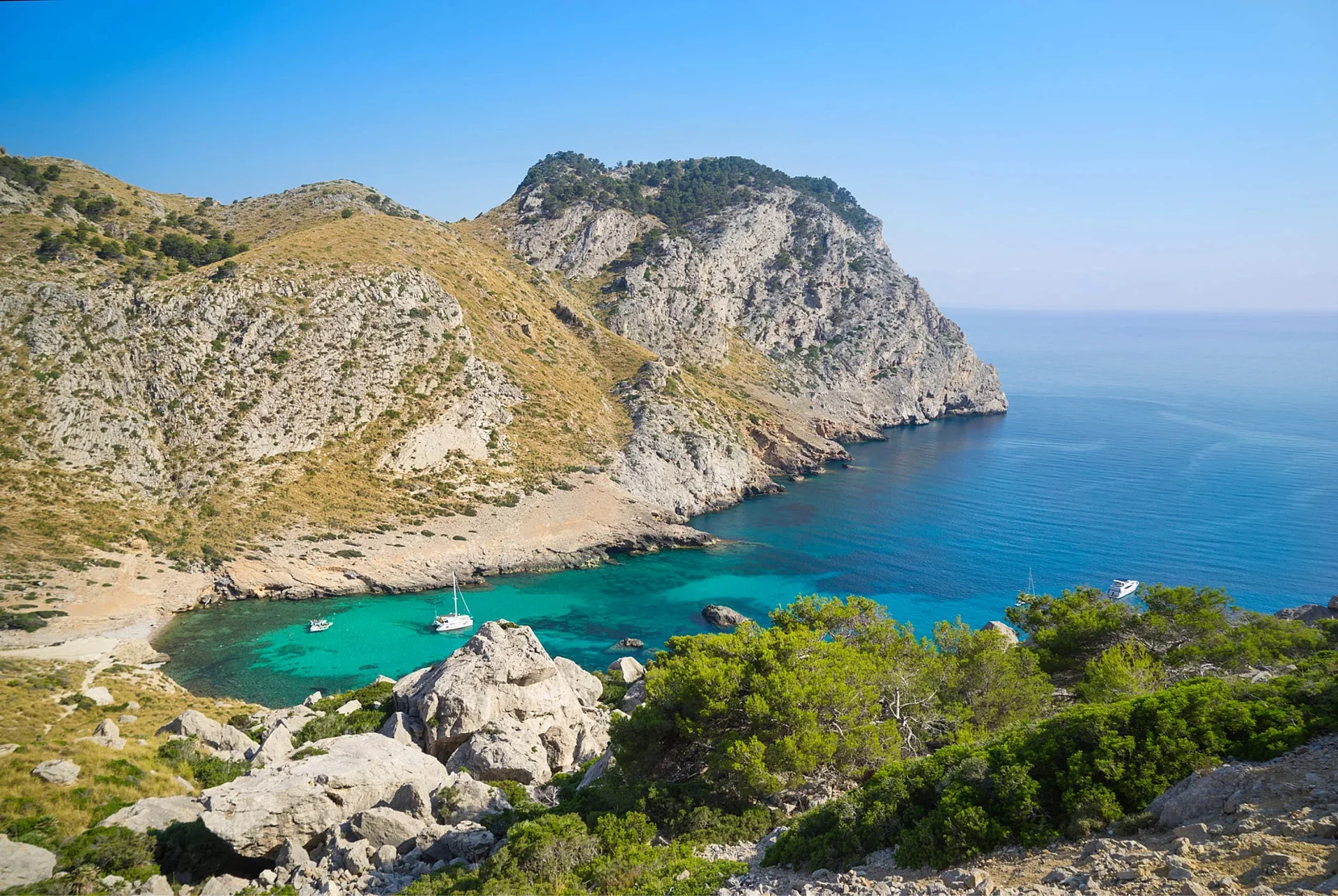
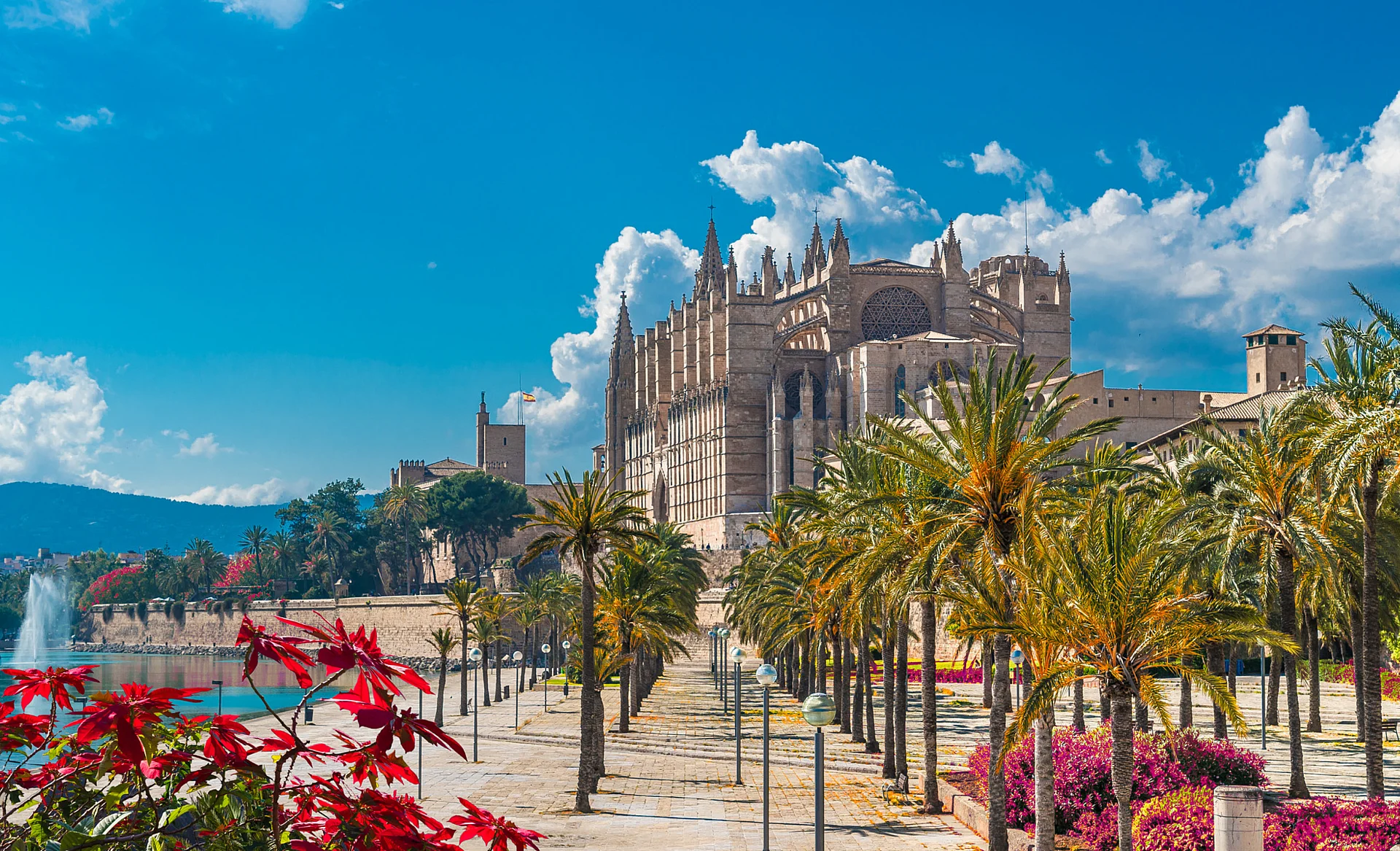
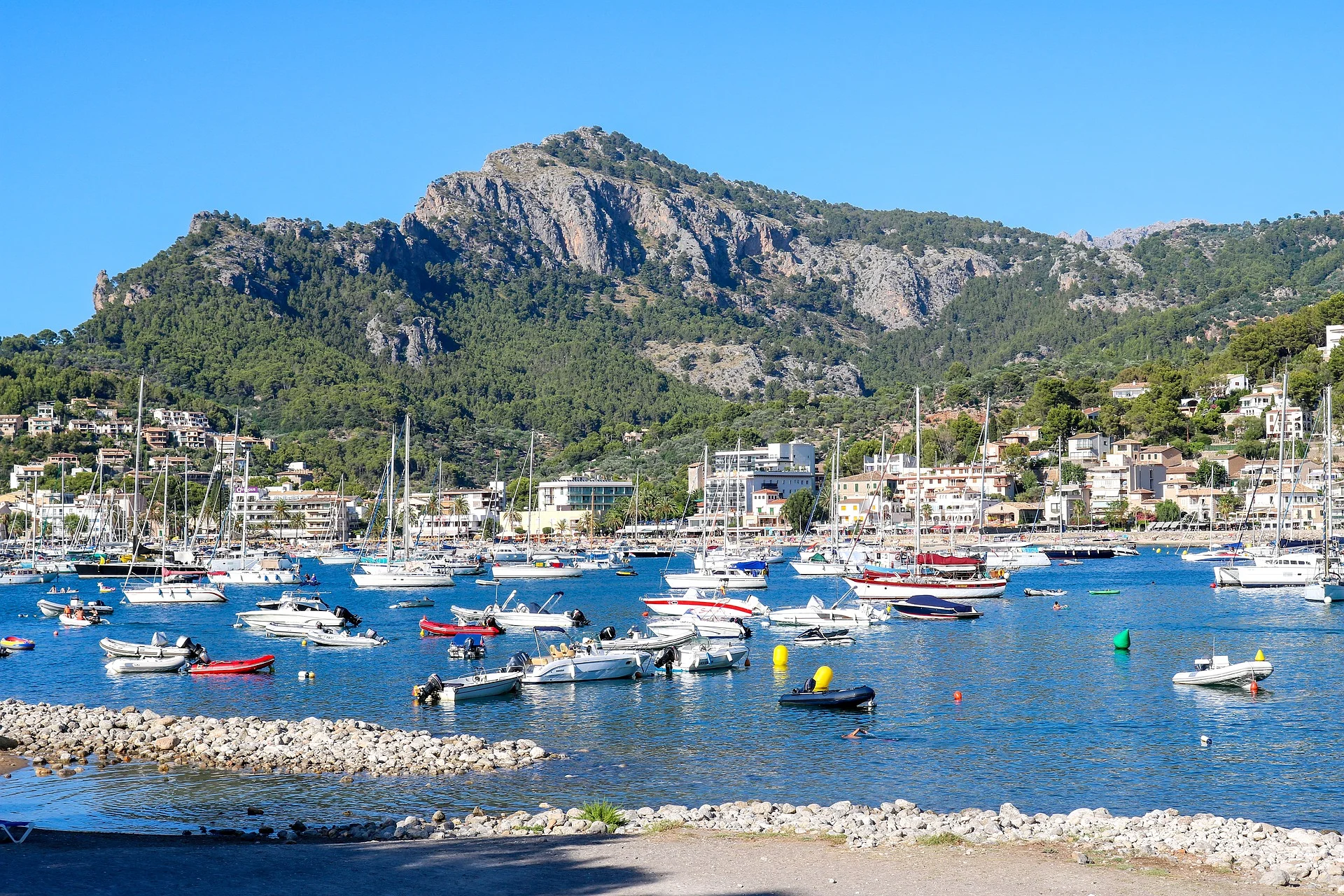
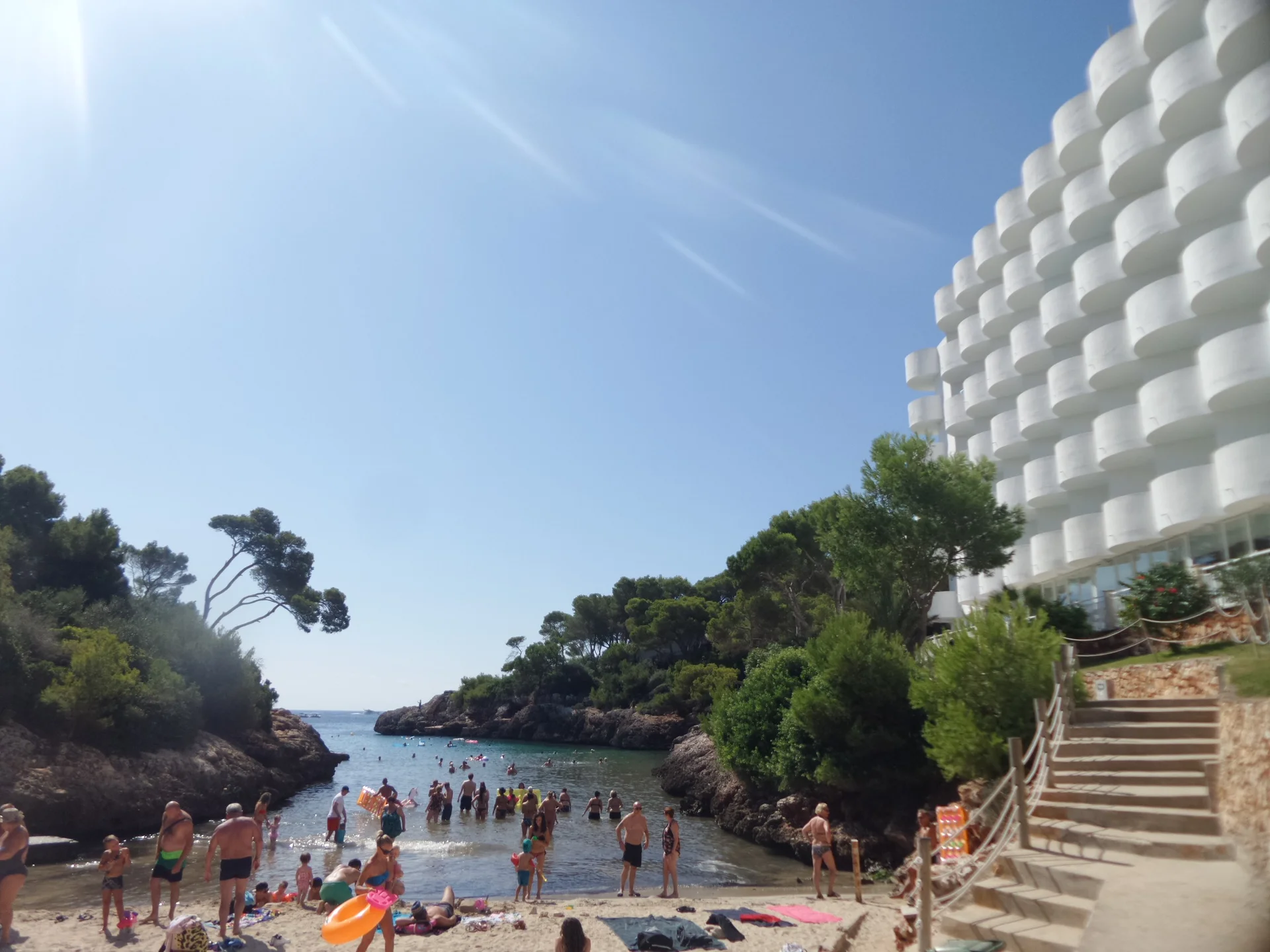
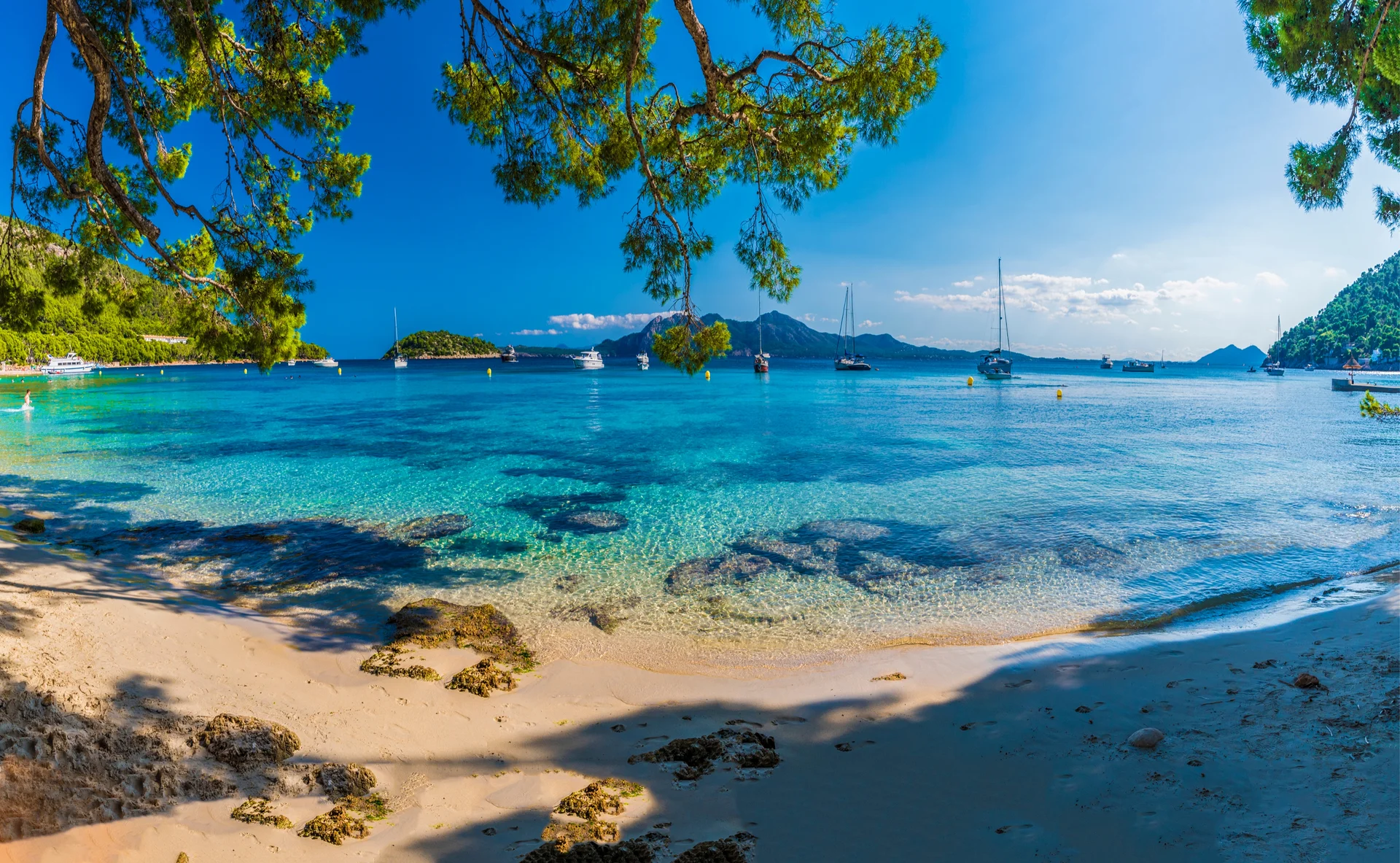
On Mallorca, choose your month first: in July and August, the coves of the southeast, such as Caló des Moro and Cala Mondragó, are packed by 10 am; in May, June, September and October, you find a spot on the sand far more easily. Then split your stay between Palma, the capital, for the cathedral by the sea and dinners in the Santa Catalina neighborhood, and Sóller, in the Serra de Tramuntana, the mountains of the northwest, which you reach from Palma on a train with wooden carriages. Rent a car to get to Deià and Valldemossa, two villages in the mountains, and to the coves.
At a glance
- When to go
- Go in May, June or September: 23 to 28 °C (73 to 82 °F), the sea between 19 and 25 °C (66 and 77 °F), and coves far less crowded than in July and August. In October, the sea is still at 22 °C (72 °F), but the days get shorter.
- How many days
- Plan seven days: three nights in Palma and three in Sóller, with one day at the coves of the southeast and one in Pollença and on Cape Formentor, in the north of the island. Four or five days are enough for Palma, Sóller and the Serra de Tramuntana.
- Where to base yourself
- Stay in Palma for a first visit, in the old town, then in Sóller or in a mountain village, Deià, Valldemossa or Fornalutx, for quiet evenings.
- Budget for two
- Count on about $2,860 for a comfortable week, with hotels, meals, a rental car and the Sóller train, flights not included; about $1,650 if you keep it simple.
- The moment for two
- Walk up to the Cap Gros lighthouse, above Port de Sóller, for the sunset over the sea, then have dinner at one of the fish restaurants on the harbor.
- Book ahead
- Book the rental car when you book your flights, the hotel in Sóller or Deià several months ahead for a stay between May and September, and the Sóller train online a few days before.
Why Mallorca for two
Mallorca is the largest of the Balearic Islands, off the coast of Barcelona and Valencia. In the northwest, the Serra de Tramuntana, a UNESCO World Heritage site, drops into the sea in cliffs, with stone villages clinging to the slopes; in the east and southeast, the coast breaks into small coves of white sand and turquoise water, the calas.
In the southwest, Palma, the capital, has its Gothic cathedral on the waterfront, its narrow streets and restaurants that stay open late, fifteen minutes from the airport. In a week, you go from the terraces of Palma to the orange groves of Sóller, then to a cove where you swim before the crowds arrive.
When to go
| Period | Weather | Crowds | Our take |
|---|---|---|---|
| April and May | 19 to 24 °C (66 to 75 °F), sea 16 to 19 °C (61 to 66 °F) | Moderate, heavier at Easter | Mountain hikes and villages without the heat; the sea stays cool until late May |
| June and September | 26 to 29 °C (79 to 84 °F), sea 22 to 25 °C (72 to 77 °F) | Heavy | Our favorite time: warm sea, long evenings, coves less full than in summer |
| July and August | 29 to 32 °C (84 to 90 °F), sea 26 °C (79 °F) | Very heavy | Packed coves, parking lots full by 10 am, hotels at top prices; swim early in the morning |
| October | 22 to 24 °C (72 to 75 °F), sea 22 °C (72 °F), first rains | Moderate | Swimming still possible and lower prices; a few storms |
| November to March | 15 to 19 °C (59 to 66 °F), rain and wind | Light | Palma stays open, but many hotels on the coast and in the mountains close; the almond trees bloom in February |
From November to March, the museums and restaurants of Palma stay open; in Sóller, Deià and on the east coast, many hotels close, and the Sóller train stops running from late November to late January: check the dates and timetables before you book.
When to go: the climate in Palma
The best months: March, April, May, June, July, August, September.
- Jan 15° 6° 7 rainy days Sea 14°
- Feb 16° 7° 6 rainy days Sea 13°
- Mar 18° 9° 5 rainy days Sea 14° best month
- Apr 21° 11° 6 rainy days Sea 16° best month
- May 24° 14° 5 rainy days Sea 18° best month
- Jun 28° 18° 3 rainy days Sea 22° best month
- Jul 32° 21° 1 rainy day Sea 25° best month
- Aug 32° 22° 2 rainy days Sea 26° best month
- Sep 29° 20° 4 rainy days Sea 25° best month
- Oct 25° 16° 6 rainy days Sea 22°
- Nov 20° 11° 8 rainy days Sea 19°
- Dec 16° 8° 7 rainy days Sea 16°
Monthly averages, in degrees Celsius.
Paperwork: passport, visa, health
| Documents | Visa | Health | |
|---|---|---|---|
| United States, Canada | Passport valid at least 3 months after you leave the Schengen area, issued within the last 10 years | None for stays up to 90 days | Travel insurance with medical cover |
| United Kingdom | Passport valid at least 3 months after you leave the Schengen area, issued within the last 10 years | None for stays up to 90 days in any 180 | Your free GHIC covers state healthcare in Spain; travel insurance for the rest |
| Ireland | Passport in date, checked at boarding and at the hotel | None | Free EHIC for public healthcare |
Entering the Schengen area from the US, Canada or the UK
On your first entry into the Schengen area, border police record your fingerprints and a photo (the EES system): allow a little more time at passport control, in Palma or at the airport where you change planes, if it is in the Schengen area. In summer, the queues at Palma can be long when several flights from the UK land together.
Check before you leave whether the ETIAS travel authorization is required on your dates: you apply for it online on the European Union site (travel-europe.europa.eu), and it is valid for three years.
Getting there
By plane: Palma airport
| From | Flight time | Good to know |
|---|---|---|
| London (Gatwick, Stansted, Luton) | ~2h15 | Many nonstops a day in summer, fewer in winter: easyJet, Ryanair, Jet2, British Airways |
| Manchester, Birmingham, Bristol, Leeds, Newcastle | 2h20 to 2h45 | Nonstops with Jet2, TUI, easyJet and Ryanair, most of them from April to October |
| Edinburgh, Glasgow, Belfast | 2h45 to 3h | Nonstops with Jet2, easyJet and Ryanair, mainly in summer |
| Dublin, Cork | 2h35 to 3h | Nonstops with Aer Lingus and Ryanair, most frequent from April to October |
| New York (Newark) | ~8h | A United nonstop in summer, several times a week; from other US cities, one stop in Europe, 11 to 16 hours |
| Montreal, Toronto | 7h40 to 12h | An Air Canada nonstop from Montreal in summer; from Toronto, one stop in Europe |
Palma airport (PMI) is fifteen minutes from central Palma, thirty-five minutes from Sóller through the tunnel, fifty minutes from Pollença and forty-five from Santanyí.
By ferry from Barcelona or Valencia
If you are combining Mallorca with Barcelona or Valencia, ferries link both cities to the port of Palma, by day or overnight in a cabin; the crossing from Barcelona takes seven to eight hours depending on the ship. With a car, book its space several weeks ahead for July and August.
Practical things to know before you leave
Phone
US and Canadian plans charge roaming at full price, and most UK plans now charge for Europe too: turn on a travel pass or install a European eSIM before you leave. With an Irish plan, calls and data work as at home, Spain being in the European Union. Download an offline map of the island: the signal drops on the mountain bends and at the bottom of the coves.
Outlets
Spanish outlets, at 230 volts, take plugs with two round pins. American, Canadian, British and Irish plugs do not fit: bring an adapter, one per person. North American appliances must accept 230 volts, which almost all phone and laptop chargers do, but rarely hair dryers.
Money and tipping
- The euro; cards work almost everywhere, but pay cash at beach kiosks, markets and some cove parking lots: keep $33 on you.
- Service is included and tipping is not expected as it is in the US: leave a few euros or round up the check if the service pleased you.
- At ATMs and card terminals, decline the conversion into dollars or pounds and pay in euros: your own bank gives a better rate.
Language and water
Mallorcans speak Catalan, in its Mallorcan form, and Spanish; signs and menus are often in Catalan first. In hotels and restaurants, English is spoken everywhere. A few words are welcome: bon dia (good morning), gràcies (thank you). Tap water is safe but very hard: buy bottled water, as the Mallorcans do.
What to book, and how far ahead
From May to September, book three things early, as they run out fast: rental cars at a fair price, the rooms in Sóller, Deià and Valldemossa, which are few, and seats on the mid-morning Sóller trains.
| What | Price | Book | Good to know |
|---|---|---|---|
| Rental car | $39 to $88 / day | With your flights | A small car is easier in the mountain villages and in the cove parking lots |
| Hotel in Sóller, Deià or Valldemossa | $198 to $660 / night | 3 to 6 months ahead, May to September | Few hotels, often closed in winter |
| Sóller train, round trip from Palma | ~$33 / pers. | Online, a few days ahead | The streetcar to Port de Sóller costs extra, ~$11 / pers. each way |
| Palma Cathedral | Paid ticket | Online or on site | Closed to visits on Sundays; come at opening time |
From the airport to your hotel
© OpenStreetMap contributors
The airport and the bases it serves
- Palma Airport (PMI)
- 1Palma, old town
- 2Sóller
- 3Deià, Valldemossa
- 4Pollença
- 5Santanyí
| Destination | Transport | Time | Typical fare |
|---|---|---|---|
| Palma, old town | Bus A1 to Plaça d'Espanya | ~20 min. | ~$5.50 / pers. |
| Palma, old town | Taxi | ~15 min. | $22 to $33 / taxi |
| Sóller | Rental car, through the Sóller tunnel | ~35 min. | $39 to $88 / day |
| Sóller | Bus A1, then bus or Sóller train from Plaça d'Espanya | 1h15 to 1h45 | $8.80 to $33 / pers. |
| Deià, Valldemossa | Rental car | 30 to 50 min. | $39 to $88 / day |
| Pollença | Rental car, via the Inca highway | ~50 min. | $39 to $88 / day |
| Santanyí | Rental car | ~45 min. | $39 to $88 / day |
What works best
If you start in Palma, do not pick up the car on arrival: take the A1 bus or a taxi, and collect the car the day you leave the city, at the airport or at a rental office downtown. If you head straight to Sóller or Pollença, pick it up at the airport, where all the major rental companies have a desk, and check whether yours is inside the terminal or a few minutes away by shuttle.
Getting around
By car, outside Palma
Highways link Palma to the airport, to Inca and to the north, and the Sóller tunnel, toll free, puts Sóller half an hour from Palma. In the mountains, the Ma-10 road, which runs along the coast from Andratx to Pollença, is narrow and winding, shared with cyclists and tour buses: allow an hour for 40 km (25 miles). Allow fifty minutes from Palma to the coves of Santanyí. Traffic drives on the right, which takes attention for British and Irish drivers on the bends.
Parking
In Palma, use an underground parking garage, such as the one on Avinguda Antoni Maura, below the cathedral: street spaces are rare and paid. The cove parking lots, some of them paid, as at Cala Mondragó, are full by 10 am in July and August, and the mountain villages, Deià and Fornalutx above all, have only a few spaces at their entrance.
Train, bus and the Formentor road
The Sóller train, with its wooden carriages, climbs from Palma to Sóller in about an hour, then a streetcar runs down to the port. The island buses, the TIB, leave from the bus station at Plaça d'Espanya, in Palma. From mid-May to mid-October, from 10 am to 10 pm, the road to the Formentor lighthouse is closed to cars, and the road to the beach as soon as its parking lot is full: take the bus from Port de Pollença, the harbor town on the Bay of Pollença, or drive up before 10 am.
Budget for two
Mallorca costs more than mainland Spain, especially the hotels in the mountains and on the coast in summer; meals stay reasonable away from the seafronts. For a week for two, flights not included, count on:
| Smart | Comfort | Treat | |
|---|---|---|---|
| Hotel, per night | $110 to $165 (a simple hotel in Palma or Sóller) | $220 to $330 (a restored palace in Palma, a boutique hotel in Fornalutx) | from $550 (La Residencia in Deià, the Four Seasons at Formentor) |
| Meals, per day for two | $66 (pa amb oli, a set lunch, a simple dinner) | $121 (lunch facing the sea, a fish dinner) | $250 (a chef's restaurant and a good bottle) |
| Car, per day | $39 plus fuel | $61 plus fuel | $99 for a large automatic |
| Train, parking and sights | $99 | $165 | $440 with a boat trip |
| Total, seven days | ~$1,650 | ~$2,860 | from $6,050 |
Useful benchmarks: a coffee with milk $2.20 to $3.30, an ensaïmada $2.20 to $4.40, a pa amb oli $8.80 to $14, a set lunch $17 to $22, a fish dish $22 to $33, a Sóller orange ice cream $3.30 to $4.40.
Specialties to try
Mallorcan food is country cooking, built on pork, olive oil and vegetables, and you find it in the inland villages more than on the seafronts. At breakfast, the cafés of Palma serve the ensaïmada warm.
To eat
-
Ensaïmada
A light spiral pastry dusted with powdered sugar: plain at breakfast, or filled with cream or with angel hair, a squash jam, for dessert.
-
Pa amb oli
Country bread rubbed with tomato and drizzled with olive oil, served with ham, Mahón cheese from the neighboring island of Menorca, and capers: the simple lunch of the Mallorcans.
-
Sobrassada
A soft red pork sausage seasoned with paprika, spread on bread, sometimes grilled and served with honey.
-
Tumbet
Fried eggplant, potatoes and peppers in layers under a tomato sauce, served in summer with fish or meat.
-
Sóller oranges
Try the oranges of the Sóller valley as fresh juice, ice cream or sorbet, at the ice cream shops on the main square of Sóller and at the port.
-
Gató d'ametlla
A cake made with the island's almonds, served with almond ice cream: the dessert of the village restaurants.
To drink
Try the island's wines, from Binissalem, in the center of Mallorca, and from Pla i Llevant, in the east: a red wine made from manto negro, the local grape, or a crisp white wine with fish. After the meal, Mallorcans pour herbes, an anise liqueur flavored with herbs from the mountains, dry or sweet.
Customs and rules to know
A few simple habits are appreciated by the people who live in the mountain villages, where visitors are many in summer.
| Rule | What to expect |
|---|---|
| Entering a church with bare shoulders or knees | Entry refused; a scarf in your bag is enough |
| Walking around Palma or a village in swimwear | Frowned upon; put on a T-shirt and shorts when you leave the beach |
| Parking outside marked spaces in Deià or Fornalutx | A fine, and sometimes towing |
| Drinking alcohol in the street in Palma | Banned by the city, with fines |
Mallorcans have lunch around 2 pm and dinner around 9 pm; in the villages, many shops close between 1:30 pm and 5 pm. On the mountain roads, do not stop on a bend for a photo: use the viewpoints, the miradors.
Safety
Mallorca is safe for a couple, day and night; trouble comes mostly from car break-ins, the roads and the sea.
- Pickpockets around Palma Cathedral, on the Passeig del Born and on the airport buses: keep your bag closed and in front of you.
- The car parked above the coves: leave nothing in sight, bags, phones or suitcases, especially on the days you arrive and leave.
- The Ma-10 road: tight bends, cyclists in groups and tour buses that take up the whole road; slow down and honk before a blind bend.
- The sea: a red flag means no swimming, and some coves have no lifeguard; do not swim far out when the wind picks up.
- The sun from June to September: there is little shade in the coves; arrive early and carry water for the access trails.
Mistakes to avoid as a couple
Two mistakes come up most often on Mallorca: spending the whole week in one beach hotel, and reaching the coves in late morning.
- Arriving at Caló des Moro or Cala Mondragó after 10 am in summer: the parking lots are full and the sand is covered in towels.
- Choosing a hotel in Magaluf, west of Palma, or on Playa de Palma, at El Arenal, for a trip for two: these are the party districts, loud until morning.
- Visiting Palma Cathedral on a Sunday: it is closed to visits that day.
- Driving up to the Formentor lighthouse in the middle of a summer day: the road is closed to cars from 10 am to 10 pm, and you risk a fine.
- Trying to see the whole island in a week: keep the northeast coast, Cala Ratjada and Artà, for another trip.
Mallorca
Compare hotel prices
Pick your dates and see the offers from the major booking sites side by side.
Compare live offers from Booking, Expedia, Agoda and other partners.
Mallorca: find your hotel
Frequently asked questions
How many days do you need for Mallorca as a couple?
Seven days are enough for Palma, Sóller and the Serra de Tramuntana, a day at the coves in the east and one in Pollença and Formentor, with two hotels. With four or five days, keep Palma, the Sóller train and the mountain villages.
Do you need a car on Mallorca?
Yes, as soon as you leave Palma: buses barely serve the coves of the southeast, and those to Deià and Valldemossa are infrequent. Rent it the day you leave Palma, for $39 to $88 a day depending on the season, and choose a small car. Most rental cars are manual: if you want an automatic, book it early.
What is the best time of year for a couple on Mallorca?
May, June and September: the sea is between 19 and 25 °C (66 and 77 °F), the coves are less crowded than in July and August, and the mountain hotels are open. For Palma alone, winter works too, at lower prices.
Is the Sóller train worth the price?
Yes, at least one way: the train crosses the mountains through tunnels and over viaducts, then runs down into the orange groves of the Sóller valley. Count on about $33 per person for the round trip from Palma, and take the bus back if you want to save time.
Is Mallorca only about beaches and parties?
No: the parties are concentrated in Magaluf and on Playa de Palma. For a couple, Mallorca means the stone villages of the Serra de Tramuntana, the old town of Palma and the small coves of the east, far from those districts.