

D1 Day 1: the Casco Viejo, the Ribera and Begoña
- D1·1Ribera market Market
- D1·2Santiago Cathedral Church
- D1·3Basilica of Begoña Church
- D1·4Arriaga Theater Landmark
- D1·5Plaza Nueva Square

With two days, keep the Casco Viejo and its bars for the first, the Guggenheim and the Artxanda funicular for the second: that is the heart of the city, walkable end to end. On the third, take the metro down the river to the Bizkaia Bridge and the beaches of Getxo; on the fourth, drive the coast road to the hermitage of San Juan de Gaztelugatxe and the port of Bermeo. Keep a museum day in reserve: the rain often decides the order.
© OpenStreetMap contributors
D1 Day 1: the Casco Viejo, the Ribera and Begoña
D2 Day 2: the Guggenheim, the river and Artxanda
D3 Day 3: down the river to the sea, Portugalete and Getxo
D4 Day 4: Gaztelugatxe, Bermeo and Mundaka
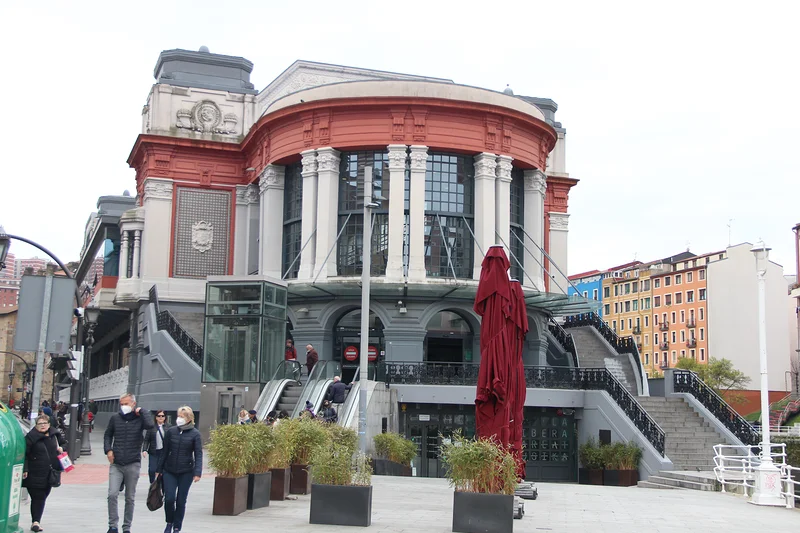
Start at 10 am at the Ribera market, the large covered market of 1929 on the riverbank: fish stalls on the ground floor, meat and cheese upstairs, stained glass on the facade, and on the ground floor the counters of the Gastroplaza, closed Mondays and Tuesdays, for a first pintxo. Most stalls close around 2 pm, and all of them are closed on Sundays.
Then walk into the Seven Streets, the oldest in the city, as far as Santiago Cathedral, which is Gothic, and its cloister; the visit takes half an hour, audio guide included.
Have lunch in the Casco Viejo, then from Plaza Unamuno climb the 351 steps of the Mallona calzadas to the Basilica of Begoña, the church of the patron saint of Bizkaia, on the hill above the old town. Come back down the same stairway.
Around 7 pm, walk past the Arriaga Theater, the 1890 Italian-style opera house on the quay, then step under the arcades of the Plaza Nueva: two pintxos and a drink at Café Bar Bilbao, then at Gure Toki and Víctor Montes, across the square. Book a table for 9:30 pm if you want to finish the evening sitting down.
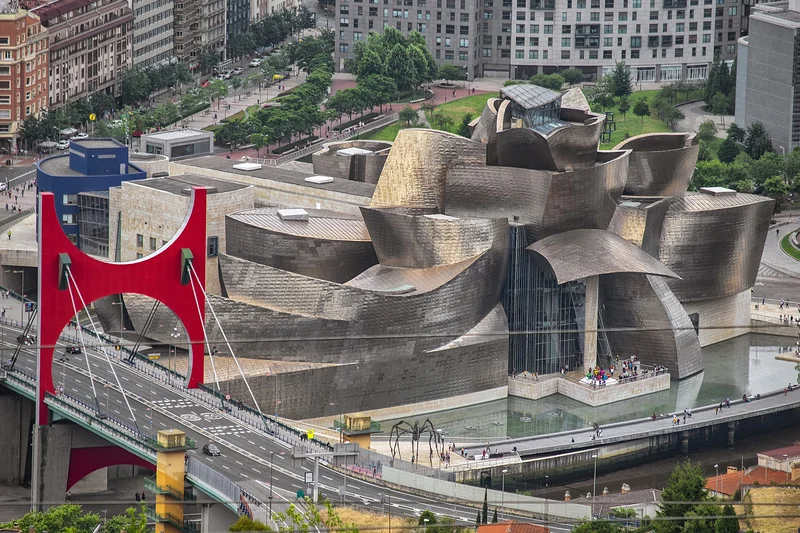
Be at the Guggenheim at 10 am, when it opens, coming in across the plaza where Puppy, Jeff Koons's dog, changes its flowers twice a year. Look at Frank Gehry's building as much as at the exhibitions: the atrium, 50 m (165 ft) high, the large gallery and Richard Serra's steel spirals. Allow two and a half hours, then leave by the river side for Louise Bourgeois's spider, Maman.
Have a pintxos lunch in the Ensanche, at La Viña del Ensanche (Calle Diputación 10) for its Iberian ham, or at El Globo, next door. Then cross Doña Casilda Park, with its pond and ducks, to the Fine Arts Museum, which covers seven centuries of painting, from El Greco and Goya to the Basque painters; an hour and a half is enough.
Around 6 pm, follow the river east and cross to the right bank on the Zubizuri bridge, Calatrava's white footbridge. At the end of Paseo Campo Volantín, the funicular climbs in three minutes to the top of Artxanda, at 250 m (820 ft): stay until sunset, when the lights come on along the river, and have a txuleta for dinner in one of the asadores at the top, or go back down to eat in town.
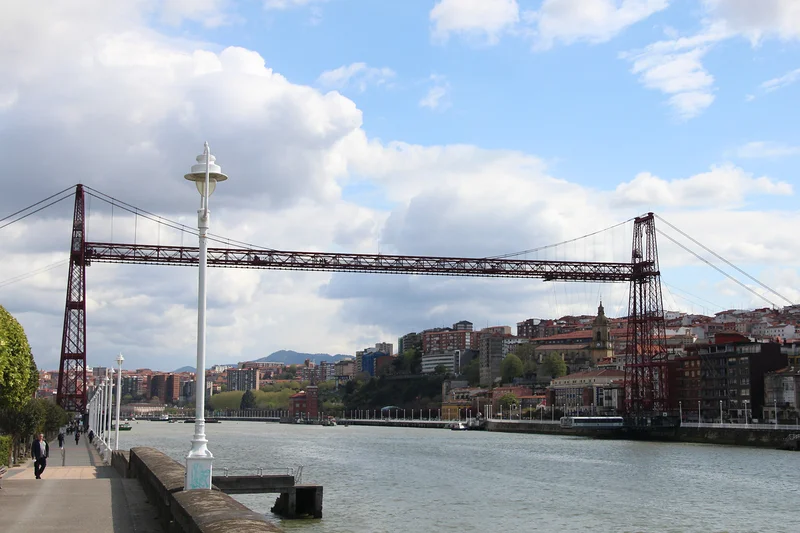
Take metro line 2 to Portugalete, twenty-five minutes from the center, and walk down through the old town to the quay. The Bizkaia Bridge, from 1893, is the world's first transporter bridge and a UNESCO World Heritage Site: a suspended gondola crosses the river every eight minutes, and an elevator takes you up to the walkway at the very top of the structure, for the view over the river mouth.
The walkway ticket, around $13, includes a gondola crossing; otherwise, the gondola alone costs less than one euro.
Get off the gondola at Las Arenas, on the Getxo side, and follow the promenade north along the bay, past the shipowners' villas from the early 20th century, to Ereaga beach: allow an hour on foot. Have grilled fish for lunch at a seafront restaurant, then, in summer, spend the afternoon on the beach.
Climb the stepped lanes of the old port of Algorta, the former fishermen's quarter, and have a glass of txakoli on a terrace facing the bay as the sun goes down. Head back to Bilbao by metro from Algorta station, in twenty-five minutes.
Leave in a rental car before 9 am: 45 minutes' drive to the access parking lots of San Juan de Gaztelugatxe, often full from 10 am. The path goes down to the causeway, then 241 steps climb the rock to the hermitage; ring the bell three times, as tradition has it, and allow two hours there and back. On controlled-access days, you need the free pass booked in advance to get through.
Drive down to Bermeo, ten minutes away, the coast's big fishing port: have fish or txipirones for lunch at the old harbor, in front of the colorful houses and the boats, then visit the Fishermen's Museum, in a 15th-century tower.
Continue to Mundaka, at the mouth of the Urdaibai estuary, a biosphere reserve: walk to the Santa Catalina hermitage, on its headland, to watch the surfers ride the river-mouth wave at sunset. Drive back to Bilbao in forty minutes for a last dinner.
In the evening, Bilbao eats standing up, from counter to counter: two pintxos and a drink per bar, three or four bars in an evening, and a dinner that comes to under $50 for two. At weekday lunch, the set menu at $17 to $25, with starter, main course, dessert and wine, is the best deal in town.
Plaza Nueva
Café Bar Bilbao (Plaza Nueva 6, opened in 1911, with its tiled decor), Gure Toki (Plaza Nueva 12, cooked pintxos) and Víctor Montes (Plaza Nueva 8), under the arcades.
Calle Diputación
La Viña del Ensanche (Calle Diputación 10, Iberian ham) and El Globo (Calle Diputación 8, the foie gras pintxo and the spider crab one).
At the market
The Gastroplaza counters at the Ribera market, on the ground floor, serve pintxos and simple dishes into the evening from Wednesday to Sunday, even when the stalls are closed.
For a special occasion
Nerua, the Guggenheim's Michelin-starred restaurant, and Mina, on Calle Ercilla in the Ensanche: tasting menus to book one to two months ahead.
Outside the city
Azurmendi, in Larrabetzu, about twenty minutes' drive away, three Michelin stars, one of the most acclaimed restaurants in Spain, in a building surrounded by txakoli vineyards; book weeks ahead.
Have your drink at the bar, along with the pintxos, from 7 to 10 pm; later on, the bars of the Casco Viejo and the Ensanche stay open until 1 or 2 am on weekends.
| In the mood for | Where | Our take |
|---|---|---|
| A historic café | Café Iruña, on the Albia gardens, opened in 1903 | Neo-Moorish ceilings and tiles, and skewers at the bar |
| A txakoli at the bar | The bars of the Plaza Nueva and the Seven Streets | Poured from a height, with a pintxo, the local way |
| A drink facing the sea | The terraces of the old port of Algorta, in Getxo | At sunset, after a day along the river |
| A drink facing the Guggenheim | The bar of The Artist hotel, the former Gran Hotel Domine, opposite the museum | The view of the titanium curves as they light up |
Late at night, Calle Licenciado Poza, in the Ensanche, and the streets of the Casco Viejo are the liveliest; do not let the night drift toward Calle San Francisco.
An opera or a concert
The Euskalduna concert hall, at the end of the Abandoibarra promenade, hosts the ABAO opera season and the Bilbao Symphony Orchestra, from September to June.
The Arriaga Theater
The 1890 Italian-style theater on the Casco Viejo quay: plays, dance and concerts, with seats from $17.
A local gig
Kafe Antzokia (Calle San Vicente 2), a former movie theater turned concert hall and bar: rock, Basque music and dance nights on weekends.
An Athletic match
At San Mamés, the club that fields only players born or trained in the Basque Country: an evening in a red-and-white crowd, tickets one to three weeks ahead.
The city's festivals
BBK Live in July, on Mount Kobetamendi; Aste Nagusia in August, nine days of free concerts and fireworks over the river.
Bilbao sits in the middle of the Basque coast: San Sebastián to the east, Guernica and Vitoria less than an hour away, Rioja to the south. The coast of Gaztelugatxe, Bermeo and Mundaka is covered on day four.
San Sebastián, 1h15 by bus
La Concha bay, Mount Urgull, the old town and its pintxos bars: leave before 10 am, come back around 8 pm.
Guernica, one hour by train
The town bombed in 1937 and painted by Picasso: the Assembly House and the Tree of Guernica, symbol of Basque freedoms, and the Peace Museum.
Vitoria-Gasteiz, one hour by bus
The capital of the Basque Country, its almond-shaped old town, Santa María Cathedral, which you can visit while it is being restored, and its ring of parks.
Rioja Alavesa, 1h30 by car
The walled village of Laguardia with its wine cellars dug under the streets, and bodegas designed by star architects, such as Marqués de Riscal in Elciego: go by car, and book tastings a week ahead.
Bilbao
Pick your dates and see the offers from the major booking sites side by side.
Compare live offers from Booking, Expedia, Agoda and other partners.
Bilbao: find your hotel
Two days are enough for the Casco Viejo, the Ribera, the Guggenheim and Artxanda. A third day adds the river down to the Bizkaia Bridge and Getxo; a fourth takes you along the coast to Gaztelugatxe and Bermeo, or to San Sebastián.
Spend the day at the Guggenheim and the Fine Arts Museum, five minutes apart, have lunch at the Ribera market, which is covered, and keep the bars of the Plaza Nueva, under their arcades, for the evening. Save the coast for the first dry day.
Yes. From June to September, the Bizkaibus A3517 runs directly from Bilbao; the rest of the year, take a bus to Bakio, then the A3524 minibus, which takes cash only. By car, allow 45 minutes from Bilbao: the small access parking lots are often full from 10 am to 4 pm, so arrive early.
At the top of Artxanda, after three minutes on the funicular, for the whole city below you; on Ereaga beach or at the old port of Algorta, in Getxo, for the sun setting over the sea.
Yes: 1h15 to 1h30 by direct bus from Termibus, with departures roughly every half hour. Leave before 10 am, have pintxos for lunch in the old town, walk along La Concha in the afternoon and catch the bus back around 8 pm.