





D1 Day 1: the center, the palace and the evening dance
- D1·1Ubud Market Market
- D1·2Pura Taman Saraswati Church
- D1·3Puri Lukisan Museum Museum
- D1·4Jalan Kajeng Neighborhood
- D1·5Ubud Palace Landmark

Only one morning of this plan needs a driver: the Tegallalang rice terraces and the spring temple of Tirta Empul, to the north, which you start at 7 a.m. The other three days are on foot, from Ubud Palace to the Monkey Forest and the Campuhan ridge, with a trail early in the morning, a break through the hot hours, and a dance show or a dinner at night.
© OpenStreetMap contributors
D1 Day 1: the center, the palace and the evening dance
D2 Day 2: the Monkey Forest, Nyuh Kuning and the ARMA museum
D3 Day 3: Tegallalang at dawn, Tirta Empul and Goa Gajah
D4 Day 4: the Campuhan ridge and the Ayung valley
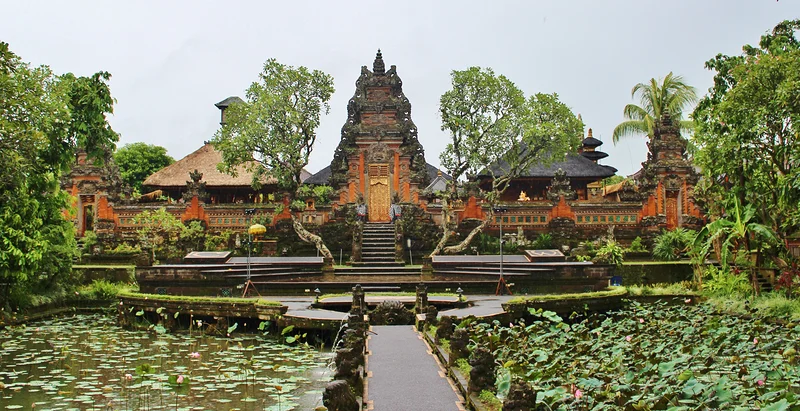
Get to Ubud Market, across from the palace, before 8 a.m.: on the ground floor, women buy the flowers, palm leaves and fruit for the day's offerings. Then walk up to Pura Taman Saraswati, the temple of the goddess of the arts, 200 m (650 ft) away: a path crosses a pond covered in lotus flowers, most of them in bloom in the morning.
Around 10 a.m., go into the Puri Lukisan Museum on the main street: in pavilions set in a garden, it traces Balinese painting from the 1930s on, with scenes of rice fields and ceremonies painted by Ubud's artists. Allow an hour.
After lunch and a nap, set off around 4 p.m. up Jalan Kajeng, north of the main street: its paving stones carry engraved names, and the street ends in the rice fields. Follow the path through the paddies for half an hour, have a juice at a café at the edge of a field, and head back before 6:30 p.m., when night falls.
At 7:30 p.m., the show starts in the courtyard of Ubud Palace, the royal family's residence: most often the legong, danced by young women with very precise gestures, or the barong, to the sound of the gamelan, the percussion orchestra. Buy tickets in the afternoon, arrive at 7 p.m. for the front row, then have dinner on Jalan Goutama, five minutes away.
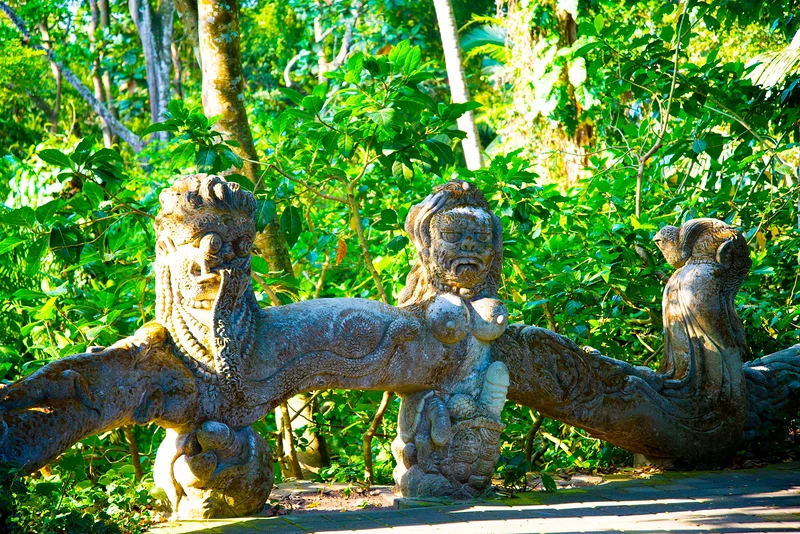
Be at the gate of the Monkey Forest at 9 a.m., at the end of Monkey Forest Road, with your bag closed and no food: paths lead down between giant banyan trees to a ravine, a moss-covered stone bridge and three temples, among several hundred macaques. Allow an hour, and let the monkeys come to you without touching them.
Leave by the south gate toward Nyuh Kuning, a village of woodcarvers with quiet, tidy streets lined with gardens: the workshops are open, and you can watch the craftsmen at work before you buy.
If you have booked a late-morning Balinese cooking class, it ends with lunch, made of the dishes you cooked. If not, walk to the ARMA Museum in Pengosekan, fifteen minutes east: its collection runs from classical Balinese painting to canvases by the European painters who lived in Ubud, Walter Spies among them, in a park of rice fields and ponds.
Around 5 p.m., treat yourselves to a one-hour Balinese massage at a salon on Jalan Hanoman, for about $11 per person. Then have dinner at a restaurant on the same street that opens onto a rice field: a bebek goreng, crispy duck, or a bebek betutu ordered the day before.
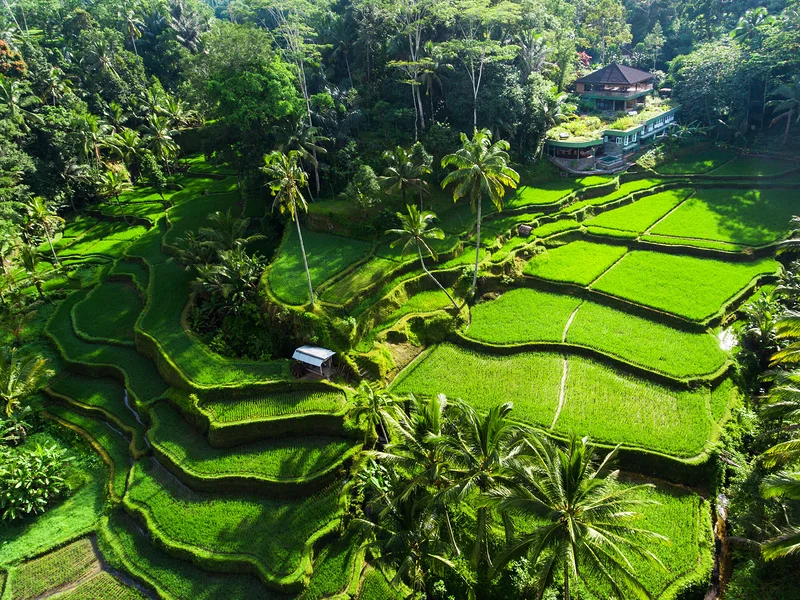
Leave at 6:30 a.m. with your driver: twenty-five minutes later, you reach the Tegallalang rice terraces, which step down both sides of a ravine planted with coconut palms. Walk down to the bottom along the dikes, then climb the other side: at this hour, you have the place almost to yourselves. Keep small bills for the farmers, who ask for a contribution each time you cross a plot.
Around 8:30 a.m., drive twenty minutes to Tirta Empul in Tampaksiring, a temple built around a sacred spring: in the main pool, the Balinese pass under each stone spout, one after another, to purify themselves. You can enter the water in a sarong; ask the attendant which spouts to skip, the ones kept for funeral rites.
On the road back to Ubud, stop at Goa Gajah, the Elephant Cave, in Bedulu: the cave entrance is carved into the cliff as the face of a demon, in front of ancient bathing pools; a stairway then leads down to a ravine and a stream. Allow forty-five minutes, then head back to the hotel around 1 p.m. for the pool.
Go up to Penestanan for dinner, west of the Campuhan bridge, by the stairway that starts from the road: the village has restaurants and cafés among the rice fields, quieter than those in the center. Bring a flashlight for the walk back.
Start at 7 a.m. from the Campuhan bridge, west of the center: walk along the wall of Pura Gunung Lebah, the temple built where the two rivers meet, then follow the paved path up onto the Campuhan Ridge, a hill of tall grass between two jungle valleys. There is no shade: at this hour, the air is still cool.
After forty minutes of walking, almost level after a short climb, the path enters the rice fields of Bangkiang Sidem: have breakfast at one of the village cafés, then walk back the same way, or call a Gojek scooter taxi to the center.
Keep the afternoon for a couples treatment at the spa of a valley hotel, booked the day before: a flower bath and a ninety-minute massage, for $66 to $132 for two. It is also the time to go back to the market for a sarong or some basketwork, at a haggled price.
Around 5:30 p.m., take a taxi to the Sayan Ridge, the road along the top of the Ayung valley, ten minutes from the center: several restaurants and hotel bars have a terrace over the gorge. Have a drink at sunset, then stay for dinner, booking the table in the morning.
A nasi campur costs $2.20 to $4.40 at a warung, dinner for two at a good restaurant $28 to $55, tax and service included. Kitchens close early, around 9:30 or 10 p.m.: book in the evening at the valley restaurants.
Ibu Oka
Ubud's best-known babi guling counter, on Jalan Tegal Sari, a few minutes' walk from the palace: go before 1 p.m., as the suckling pig often runs out by mid-afternoon.
Bebek Bengil
A restaurant on Jalan Hanoman with pavilions at the edge of a rice field: the crispy duck, bebek goreng, served by the half.
Warung Biah Biah
A small dining room on Jalan Goutama where you put together your meal from small Balinese plates, priced one by one.
Murni's Warung
One of Ubud's oldest restaurants, on several floors above the river at the Campuhan bridge: Balinese and Indonesian cooking, next to the start of the ridge path.
Most bars in Ubud close between 11 p.m. and midnight. A cocktail costs $6.60 to $11 in the center, twice that at a valley hotel bar.
| In the mood for | Where | Our take |
|---|---|---|
| A sunset drink | The terraces on the Sayan ridge | A view over the Ayung gorge; book a table on the edge |
| A martini and pork ribs | Naughty Nuri's, Jalan Sanggingan | A loud, cheerful place, known for its cocktails |
| A juice or a jamu | The cafés of Penestanan | For an afternoon break, in the rice fields |
| A beer before the dance | The cafés around the palace | Handy before 7:30 p.m., no fuss |
Plan the evening in three parts: a dance show around 7:30 p.m., dinner, then a drink before 11 p.m. The ticket sellers around the palace post the week's dance schedule, venue by venue.
Legong and barong
Every evening at Ubud Palace and in other temple courtyards in the center, for about $5.50 per person: an hour and a half of dance and gamelan.
Kecak
A chorus of men seated in a circle around a fire, chanting "chak" to tell the Ramayana: several temples in Ubud stage it on certain nights of the week.
A couples massage
Hotel spas offer treatments for two in a pavilion above the valley, from $66 to $132; a neighborhood salon charges $8.80 to $17 an hour per person.
A night walk
In the rice fields, on the way back from dinner, fireflies and frogs: bring a flashlight, and stay on the wide dikes.
| Destination | Getting there | What for | Our take |
|---|---|---|---|
| Mount Batur | Car, ~1h15 | A night hike to watch the sun rise over a volcano and its lake | Bali's finest wake-up call, on a clear day; leave around 2 a.m. |
| Jatiluwih rice terraces | Car, ~1h30 | The island's largest rice terraces, on the UNESCO list | Bigger and quieter than Tegallalang |
| Ulun Danu temple | Car, ~1h30 | A temple on the shore of Lake Beratan, in the mountains | Pair it with Jatiluwih; it is cool up there, so bring a sweater |
| Sidemen | Car, ~1h15 | A valley of rice fields facing Mount Agung, and weaving workshops | Countryside without tour buses, for a quiet day |
| Tirta Gangga | Car, ~2h | A water palace of pools and stepping stones, in the east | A long day; better if you then stay in Amed |
Visit Jatiluwih and Ulun Danu on the same day, with a driver for 8 to 10 hours. With only one day trip, choose Mount Batur if you like to hike, Jatiluwih if not.
Ubud
Pick your dates and see the offers from the major booking sites side by side.
Compare live offers from Booking, Expedia, Agoda and other partners.
Ubud: find your hotel
Four days to see the center, the Monkey Forest, the rice terraces and temples to the north, and the Campuhan ridge, with a break every afternoon. With two days, do the first two; with three, add the morning up north.
Only on day three: Tegallalang, Tirta Empul and Goa Gajah are too far to walk. Count $33 to $44 for the day; the other days, you walk, and a taxi or a Grab is enough to get back from dinner.
Yes, if you move everything to the morning: from November to March, the showers fall mostly in the afternoon. Do the trails before 11 a.m., keep the museums, the spa and the cooking class for the afternoon, and pack shoes that grip in mud.
Yes: you step into the pool in a sarong, lent or rented at the temple entrance, and pass under the stone spouts in the order the attendant shows you, letting the Balinese go first. Bring a change of clothes and a towel.
Yes, if the sky is clear: you climb for two hours in the dark to watch the sun rise over the lake and Mount Agung. Do it on the last morning, or in place of day four, never the day before your flight.