Melbourne for Couples: What to Know Before You Go (2026)
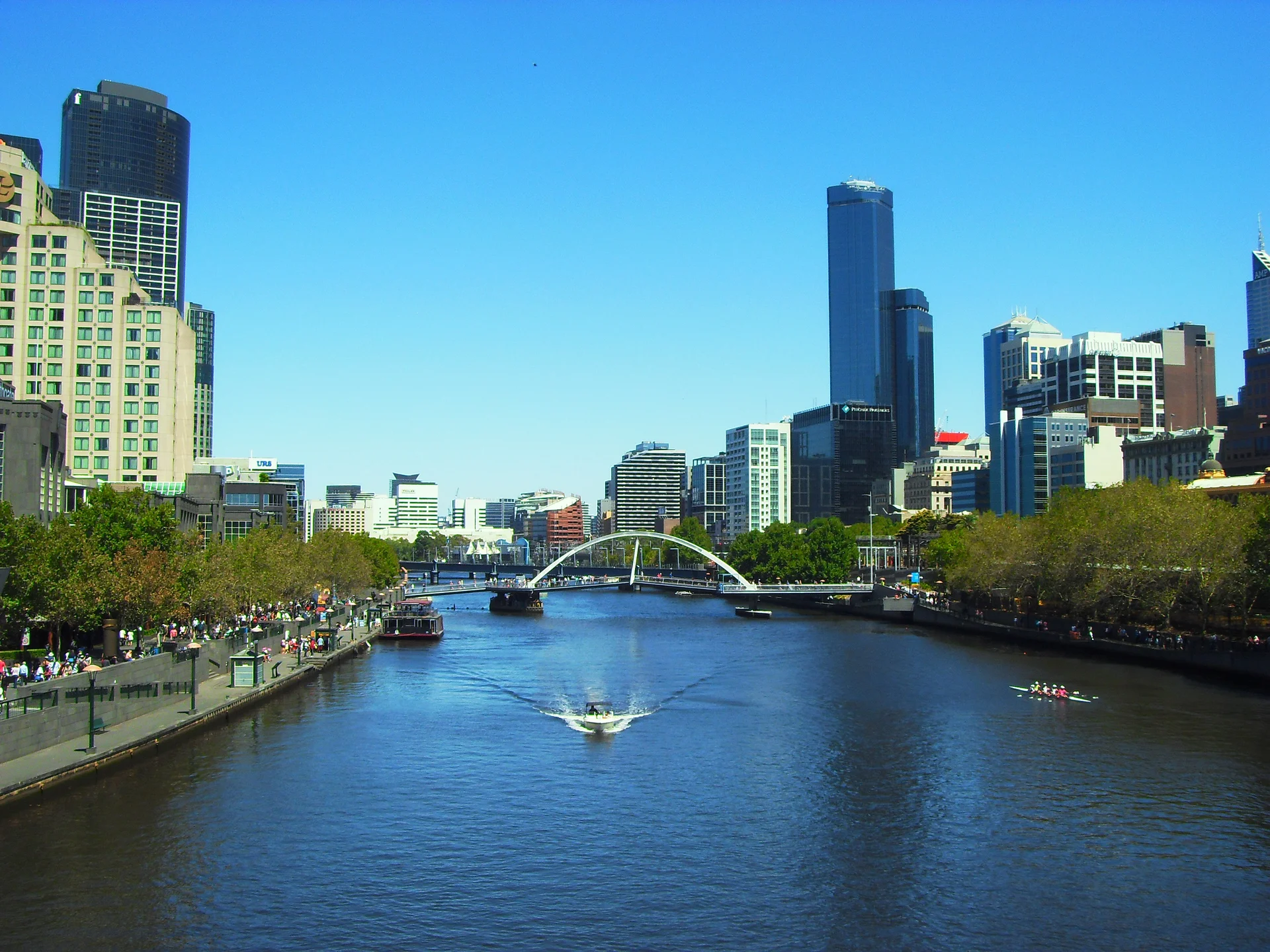
In Melbourne, the pleasure is in the details: a standing-room coffee at the end of a lane, the street art of Hosier Lane repainted every week, the Yarra on foot until sunset, Queen Victoria Market on a Saturday morning, little penguins on the St Kilda pier. Three things need sorting before you leave: the Australian entry authorization, a flight of 22 hours or more with a stop, and the Great Ocean Road, too long for a single day. The seasons are reversed (summer runs from December to February) and the weather changes several times a day: an extra layer in the bag beats the morning forecast.
At a glance
- When to go
- March to May: 63 to 77 °F (17 to 25 °C), sun without heat waves, hotels cheaper than in January. December to February is hot (up to 104 °F) and priciest; June to August is cool, 43 to 57 °F.
- How many days
- Four full days for the city, one or two more for the Great Ocean Road: plan six nights at least to absorb a 22-hour trip and a 14 to 19 hour time difference.
- Where to stay
- The CBD for a first visit, Fitzroy for cafés and bars, St Kilda for the beach, South Yarra for calm near the gardens.
- Budget for two
- About $2,130 for five nights in comfort, hotel, meals, sights and transport, flights not included: the hotel is nearly half.
- The moment for two
- Hosier Lane at 8am, almost empty, with a coffee from the next lane; at night, the Yarra and the lit skyline from the Southbank promenade.
- Before you go
- The ETA, in the official app (about $14), then a night on the spot for the Great Ocean Road instead of a 13-hour day.
Why Melbourne for two
Melbourne rewards wandering. The center is a grid of broad avenues and narrow lanes, the neighborhoods around it (Fitzroy, Collingwood, St Kilda) each have their own café strip, and trams tie it all together, so nobody needs a car. The pace is that of a long weekend: a market in the morning, a free gallery when it rains, a lane bar at night.
-
The lanes
Hosier Lane, Degraves Street, Centre Place: street art that is repainted constantly, standing-room cafés and bars hidden on the first floor.
-
The coffee
A culture of its own: locals pick a roaster the way others pick a wine, and the flat white was born in this part of the world.
-
St Kilda
A bay beach, the pier at sunset, Luna Park, and a colony of little penguins that comes home at dusk.
-
The Great Ocean Road
160 miles (260 km) of coast to the Twelve Apostles: an excursion for two days, not one.
When to go
Melbourne is in the southern hemisphere: summer runs from December to February and winter from June to August. A European or American spring trip is an autumn trip here, and autumn is the best season.
| Period | Temperatures | Our verdict |
|---|---|---|
| March to May (autumn) | 17 to 25 °C (63 to 77 °F) | Our favorite: clear skies, golden gardens, hotels cheaper than in summer |
| September to November (spring) | 14 to 23 °C (57 to 73 °F) | In bloom but unsettled: wind, showers and sunshine in the same day |
| December to February (summer) | 20 to 40 °C (68 to 104 °F) | Long evenings until 9pm and festivals, but heat waves and peak prices |
| June to August (winter) | 6 to 14 °C (43 to 57 °F) | Gray and cool, dark by 5pm; galleries and cafés make up for it, and hotels are cheaper |
Four seasons in one day
Locals say it, and it is accurate: 54 °F (12 °C) at breakfast, 75 °F (24 °C) in the afternoon, a shower at 4pm, then a cool wind at night. Even in summer, a hot northerly can push the temperature to 100 °F (38 °C) before a wind change drops it 25 °F (15 °C) in an hour. Dress in layers, carry a windbreaker and a compact umbrella, and keep an indoor plan (a gallery, a covered market, a café) for every half day.
The dates that move prices
- Australian Open: three weeks in January, qualifying included, with the finals on the last two days. Hotels and flights peak; book four to six months ahead.
- Formula 1 Grand Prix: in March at Albert Park, with pricey rooms around the circuit all weekend.
- AFL Grand Final: the last Saturday of September, at the Melbourne Cricket Ground.
- Melbourne Cup: the first Tuesday of November, a public holiday in Melbourne, for a horse race where everyone dresses up.
- Christmas and school holidays: from late December to late January, beaches, hotels and the Great Ocean Road are full.
Entry requirements: passport, authorization, health
| Documents | Entry authorization | Health | |
|---|---|---|---|
| United States | Passport valid for the whole stay; six months of validity left is the safe bet | ETA in the official Australian ETA app (~$14) | Travel insurance with medical cover and repatriation: most US health plans pay little or nothing abroad |
| Canada | Passport valid for the whole stay | ETA in the official Australian ETA app (~$14) | Travel insurance: provincial plans cover very little abroad |
| United Kingdom | Passport valid for the whole stay | ETA in the official Australian ETA app (~$14) | A reciprocal agreement covers only some urgent public-hospital care: buy travel insurance anyway |
The ETA, step by step
American, Canadian and British passport holders need an Electronic Travel Authority (ETA) before boarding. It is requested in the official Australian ETA app (App Store, Google Play), with a photo of your passport and a selfie, for an Australian service fee of 20 dollars, about $14. The answer usually comes within minutes, sometimes a few days: apply as soon as your flight is booked. The ETA is valid for a year, for stays of up to three months per entry, and is tied to your passport number: a new passport needs a new ETA.
Look-alike websites charge several times the real price: use only the app or the Department of Home Affairs website (immi.homeaffairs.gov.au). Rules change, so check the official site before you book.
On arrival
At passport control, the officer asks for the address of your first hotel and the length of your stay: write them down before you land. Biosecurity is among the strictest in the world: tick yes on the arrival declaration for any fruit, honey, dairy, wood, plant or hiking boots with soil on them. Detector dogs work the baggage hall, and the on-the-spot fine runs to hundreds of dollars for an apple forgotten in a bag.
Getting there: flights and jet lag
Nonstop from the West Coast
Nonstop flights reach Melbourne from Los Angeles and Dallas. From the East Coast, Chicago or London, count one stop, on the US West Coast, in the Gulf (Doha, Dubai, Abu Dhabi) or in Asia (Singapore, Hong Kong), and 22 to 27 hours of travel. Check current schedules: routes change from one year to the next.
| From | Route | Total time |
|---|---|---|
| Los Angeles, Dallas | Nonstop | 15 to 18h |
| New York, Boston, Chicago | One stop, on the West Coast or in Dallas | 22 to 27h |
| London | One stop, in the Gulf or in Asia | 22 to 26h |
Melbourne and Sydney are 1h30 apart by air, with flights all day: an open-jaw ticket, landing in Sydney and flying home from Melbourne, saves backtracking.
Jet lag
Melbourne is 14 to 16 hours ahead of New York, 17 to 19 ahead of Los Angeles and 9 to 11 ahead of London, depending on the time of year (Australia switches to daylight saving time in October). You also cross the date line: a Tuesday-night departure from the US lands on Thursday morning. Book the hotel from the night before you land, so the room is ready when you arrive. The body needs three or four days to catch up; the first two can be planned:
- Stay outside on day one: a walk through the lanes or the Royal Botanic Gardens beats a nap, and daylight resets the clock.
- Cap the nap at half an hour before 3pm, eat dinner around 7pm and be in bed before 10pm.
- Book nothing that costs money before day two.
Before you go: plugs, phone, money
-
Plugs
Type I, two flat blades in a V, 230 V: US plugs do not fit, so bring an adapter. Phone and laptop chargers take 100 to 240 V; hair dryers and curling irons do not.
-
Phone
Check your carrier's international day pass, or install an Australian eSIM before you leave: it works the moment you land.
-
Payment
Tap-to-pay works almost everywhere, from cafés to markets. Menu prices include the 10% GST, so unlike in the US nothing is added at the register; some shops add 1 to 2% for cards.
-
Tipping
Not expected, unlike in the US: wages are high and the price on the menu is the price. Rounding up, or 10% for a very good meal, is a thank-you, not a rule; at a café, in a cab or at a bar, nothing is expected.
-
Water
Tap water is safe and tastes good: a bottle refills in parks, stations and cafés.
-
Sun
The UV index is extreme from November to March and burns in 15 minutes, even under gray skies: SPF 50, a hat and sunglasses from breakfast on.
Australians shorten everything: g'day is hello, arvo the afternoon, heaps means a lot, and no worries answers anything. A server who says cheers is thanking you.
What to book ahead
| What | How far ahead | Why |
|---|---|---|
| Hotel during the Australian Open | 4 to 6 months | Central rooms sell out and the price doubles |
| Hotel on the Great Ocean Road | 2 to 3 months in summer | Few rooms between Lorne and Port Campbell, full in January |
| St Kilda penguins | A few days | Free sessions with limited places, booked online |
| Phillip Island Penguin Parade | 1 to 4 weeks | Grandstand seats go fast in summer |
| Dinner at Cutler & Co, Cumulus Inc. or Movida | 2 to 4 weeks | Friday and Saturday tables go first |
| Match at the Melbourne Cricket Ground | 1 to 3 weeks | Big games sell out, finals long before |
Trams, markets, galleries, gardens and most cafés need no reservation. Do not put the Great Ocean Road the day before your flight home: a coach tour is back around 9pm, and a night on the spot takes an extra day.
From the airport to your hotel
© OpenStreetMap contributors
The two airports and the neighborhoods they serve
- Melbourne Airport (MEL)
- Avalon (AVV)
- 1Southern Cross, CBD
- 2Southbank
- 3Fitzroy, Collingwood
- 4South Yarra
- 5St Kilda
| Destination | Transport | Time | Indicative fare |
|---|---|---|---|
| Southern Cross, CBD | SkyBus | 20 to 35 min. | ~$17 / pers. |
| Southern Cross, CBD | Taxi or rideshare | 25 to 50 min. | ~$56 / taxi |
| Southbank | Taxi or rideshare | 30 to 55 min. | ~$62 / taxi |
| Fitzroy, Collingwood | SkyBus then tram | ~60 min. | ~$21 / pers. |
| Fitzroy, Collingwood | Taxi or rideshare | 30 to 55 min. | ~$62 / taxi |
| South Yarra | Taxi or rideshare | 35 to 60 min. | ~$68 / taxi |
| St Kilda | SkyBus then tram 96 | ~70 min. | ~$21 / pers. |
| St Kilda | Taxi or rideshare | 45 to 70 min. | ~$73 / taxi |
| Destination | Transport | Time | Indicative fare |
|---|---|---|---|
| Southern Cross, CBD | SkyBus Avalon Express | ~55 min. | ~$18 / pers. |
| Southern Cross, CBD | Taxi or rideshare | 55 to 80 min. | ~$112 / taxi |
The SkyBus leaves about every ten minutes, day and night, and stops at Southern Cross, the main station, where trams in the center are free. There is no train to the airport. Taxis wait in the official line outside each terminal and run on the meter; a freeway toll and an airport surcharge are added. Rideshares (Uber) have their own pickup zone and cost a little less.
Avalon handles only domestic low-cost flights, 50 miles (80 km) from the center by road: an intercontinental flight lands at Tullamarine. You would only come here on a domestic connection, and the shuttle then runs around the flights, so check the timetable before you land.
Getting around: free trams and the myki
On foot and by tram
The center is a grid 1.2 miles (2 km) by 0.6 miles (1 km): the lanes, Federation Square, Southbank and Queen Victoria Market are all connected on foot. For the rest, the tram, a fixture of the city for over a century, serves Fitzroy, St Kilda and South Yarra.
The free tram zone
In the center, from Spring Street to Docklands and from Flinders Street to Victoria Street (Queen Victoria Market included), trams are free: you hop on and off without tapping a card. The City Circle (tram 35), with its vintage trams, loops the center, also free. As long as your trip stays inside the zone, do not tap your card: a tap by mistake is charged as a two-hour fare. As soon as the tram leaves the zone, heading to Southbank, Fitzroy, St Kilda or South Yarra, the myki is required and inspectors are frequent: the fine is far more than a ticket. The zone boundary is shown on the stop maps.
The myki
| Ticket | Price | Good to know |
|---|---|---|
| Free tram zone and City Circle | Free | No card to tap while your trip stays inside the zone |
| myki card | ~$4.50 | Sold at station machines and 7-Eleven stores, topped up with cash value |
| Daily cap | ~$6.80 | At the regular fare; beyond it, the rest of the day is free (zones 1 and 2, where every place in the program sits) |
Contactless bank-card payment is rolling out across the network: check on arrival before you buy a myki. The card works on trams, trains and buses.
Taxis and driving
Taxis and rideshares fill in for the tram at night. Rent a car only for the Great Ocean Road: Australians drive on the left, and in the center the hook turn has you turn right from the left lane, in front of the trams, after waiting for the light on the cross street. Hotel parking runs around $45 a night.
Budget: what Melbourne costs for two
A night's price depends on the season more than the neighborhood: the same hotel costs 30 to 50% more during the Australian Open and between Christmas and New Year. Posted prices include the 10% tax, and no resort fee is added at the desk.
| Item | Indicative price |
|---|---|
| Double room, simple hotel | up to $124 a night |
| Double room, comfortable hotel | $124 to $210 a night |
| Double room, boutique hotel | $210 to $340 a night |
| Double room, luxury hotel | over $340 a night |
| A coffee (flat white) | ~$4 |
| Café breakfast | ~$17 / pers. |
| Dinner, two courses and a glass | ~$51 / pers. |
| A cocktail | ~$16 |
| Eureka Skydeck | ~$25 / pers. |
| Coach tour of the Great Ocean Road | ~$112 / pers. |
| Gardens, markets, galleries and the free tram zone | Free |
A typical stay
Five nights in comfort come to about $2,130 for two: $960 for the hotel, $680 for meals, $510 for sights and transport, flights not included. A smart stay comes in around $1,350 by sleeping in Collingwood or St Kilda and lunching at the markets; an indulgent one tops $3,920 with a Southbank hotel and fine tables.
What to taste
-
Coffee
At the counter, a flat white (espresso with steamed milk and a thin layer of foam, smaller and stronger than a US latte), a long black (espresso over hot water, close to an americano) or a magic (double ristretto with milk, a regional favorite). Order small: the giant cup barely exists.
-
Brunch
The café staple: poached eggs, sourdough, smashed avocado, mushrooms or grilled cheese. Cafés open at 7am and serve brunch until 3pm.
-
Acland Street cakes
Central and Eastern European pastries, brought to St Kilda by families who arrived in the 1950s: chocolate kugelhopf, honey and cheese cakes, in the windows.
-
Dim sims
Fried or steamed dumplings stuffed with meat, bigger than in China, sold at markets like South Melbourne Market: lunch on the go.
-
The meat pie
A beef pie eaten on the move, with tomato sauce: bakeries sell them from $4.50.
-
Migrant cuisines
Lygon Street for Italian, Victoria Street in Richmond for Vietnamese, Oakleigh for Greek: Melbourne has one of the largest Greek communities outside Greece.
-
Wine
The Yarra Valley and Mornington Peninsula vineyards are an hour from the city: pinot noir and chardonnay, with cellar doors open for tasting.
Local etiquette
In Melbourne, good humor shows in the queue: people wait without pushing, say thanks to everyone and move to first names fast.
- At the pub, you order and pay at the bar; among friends, everyone buys a round in turn (a shout).
- Several restaurants are BYO (bring your own): you bring your own bottle of wine and pay a small corkage fee.
- On the tram, let people off before you board and give up your seat to older or disabled passengers.
- Painting a wall is a crime except in the lanes designated for it, like Hosier Lane: elsewhere, the fine is steep.
- Smoking is banned on restaurant terraces and near tram stops.
- At the St Kilda penguins, observe without flash or white light, and stay away from the rocks.
Safety
- The sun: the UV index is extreme from November to March; sunscreen every two hours, a hat and water in your bag.
- The sea: on the Great Ocean Road coast, rip currents carry swimmers away every year; swim only on a patrolled beach, between the red and yellow flags.
- Bushfires: from December to March, on total fire ban days, coastal and hill roads can close; the VicEmergency app gives the situation of the day.
- Pickpockets: at the market, on crowded trams and at Flinders Street Station, an open bag is an invitation.
- The center after midnight: when the clubs on King Street and Chapel Street empty on Friday and Saturday, take a cab rather than an empty street.
- Snakes and spiders: present in tall grass in summer, rare in town; stay on the paths, in closed shoes.
Mistakes couples make
- Doing the Great Ocean Road in a day: thirteen hours, nine of them on the road, for a few stops. Sleep in Apollo Bay or Port Campbell.
- Showing up at Queen Victoria Market on a Monday or Wednesday: it is closed, and the Wednesday night market runs only in season.
- Tapping the myki in the free tram zone: the card charges a two-hour fare for nothing.
- Leaving in shorts on the strength of the morning forecast: without a windbreaker, a 4pm shower spoils the Southbank walk.
- Forgetting to declare fruit, honey or muddy boots on arrival: the fine is immediate.
- Scheduling a paid visit on arrival day: after 24 hours of travel, the city is best seen on foot, without a ticket.
- Counting on the penguins without a reservation: the St Kilda sessions are free, but places are limited.
Frequently asked questions
Is Melbourne a good destination for a couples trip?
Yes, for couples who like to wander: street art, cafés, markets, gardens and a beach in one city, with a free tram in the center. Melbourne is less spectacular than Sydney but easier to enjoy as a pair. Its drawbacks are few: a 22-hour trip, reversed seasons and changeable weather.
How many days do you need in Melbourne as a couple?
Four full days cover the center, a market, Fitzroy, the gardens and St Kilda, one neighborhood a day. With three days, keep the lanes, Fitzroy and St Kilda. Add one or two days for the Great Ocean Road, and plan six nights in all to absorb the flight.
Do Americans need a visa for Melbourne?
Yes, but it is an online authorization: the ETA, about $14, in the official Australian ETA app, with a US, Canadian or British passport. Apply as soon as your flight is booked; it is valid for a year, for stays of up to three months. Check the official site before you book.
Melbourne or Sydney for a couple?
Sydney for the harbor, the Opera House and the beaches; Melbourne for the lanes, the cafés, the markets and neighborhood life. With two weeks, do both: the flight between them takes 1h30, and an open-jaw ticket avoids the backtrack.
Can you do the Great Ocean Road in a day?
On an organized tour, yes: 12 to 13 hours, nine of them on the road, for an hour at the Twelve Apostles. As a couple, a car and a night in Apollo Bay or Port Campbell give time for a walk, a sunset and an unhurried breakfast; the drive is 4h30 from Melbourne.
How much does a trip to Melbourne cost for two?
Count about $2,130 for five nights in comfort, with a central hotel, meals, sights and transport, flights not included. A smart budget is around $1,350 sleeping in Collingwood or St Kilda; an indulgent stay tops $3,920.